<?xml version='1.0' encoding='UTF-8'?>

<!DOCTYPE article PUBLIC "-//NLM//DTD JATS (Z39.96) Journal Publishing DTD v1.1d1 20130915//EN" "JATS-journalpublishing1.dtd">
<article xmlns:xlink="http://www.w3.org/1999/xlink">
  <front>
    <journal-meta id="journal-meta-87cddb9ab7774ac9973b6a64b7cbc767">
      <journal-id journal-id-type="nlm-ta">Sciresol</journal-id>
      <journal-id journal-id-type="publisher-id">Sciresol</journal-id>
      <journal-id journal-id-type="journal_submission_guidelines">https://jmsh.ac.in/</journal-id>
      <journal-title-group>
        <journal-title>Journal of Medical Sciences and Health</journal-title>
      </journal-title-group>
      <issn publication-format="print"/>
    </journal-meta>
    <article-meta>
        
          
            <article-id pub-id-type="doi">10.46347/jmsh.v12.i2.25.259</article-id>
          
          
            <article-categories>
              <subj-group>
                <subject>ORIGINAL ARTICLE</subject>
              </subj-group>
            </article-categories>
            <title-group>
              <article-title>&lt;p&gt;Study on the Assessment of Students’ Learning and Perception Towards the Flipped Classroom in Biochemistry&lt;/p&gt;</article-title>
            </title-group>
          
          
            <pub-date date-type="pub">
              <day>30</day>
              <month>3</month>
              <year>2026</year>
            </pub-date>
            <permissions>
              <copyright-year>2026</copyright-year>
            </permissions>
          
          
            <volume>12</volume>
          
          
            <issue>2</issue>
          
          <fpage>1</fpage>

          <abstract>
            <title>Abstract</title>
            &lt;p&gt;&lt;bold&gt;Background:&lt;/bold&gt; Medical education programs necessitate strong role models and learning environments that promote professional development and organizational behaviour. Flipped classroom (FC) is a method by which a student acquires knowledge independently before a classroom encounter. This approach effectively promotes active learning and critical thinking in students. &lt;bold&gt;Aim &amp;amp; Objectives of study: &lt;/bold&gt;To assess the effectiveness and perception of the flipped classroom teaching method and its score-based comparison to the traditional teaching method among First MBBS students. &lt;bold&gt;Methodology:&lt;/bold&gt; An observational type of study for the comparison of two different teaching methods among 100 first-year Bachelor of Medicine and Bachelor of Surgery (MBBS) students. A detailed multiple choice structured questionnaire was used to asses Students&#x27; perceptions of flipped classroom teaching versus traditional methods of instruction for both groups. Two different biochemistry topics were taught at two different levels. The assessment score between pre- and post-test scores was compared between Traditional teaching Methodology (TTM) and Flipped classroom (FCR). &lt;bold&gt;Results: &lt;/bold&gt;Overall, FCR significantly improved student performance (p&amp;lt;0.001). The majority of students believed that the combination of FCR and TTM was better suited for an in-depth understanding of topics. &lt;bold&gt;Conclusion: &lt;/bold&gt;This study highlights that FCM could be a better tool for teaching and learning in the current Techno-Digital environment.&lt;/p&gt;
          </abstract>
          
          
            <kwd-group>
              <title>Keywords</title>
              
                <kwd>Biochemistry; Teaching Learning Methods; Flipped Classroom Method; Traditional Teaching Method; Student Perception</kwd>
              
            </kwd-group>


        <contrib-group>
          
            
              <contrib contrib-type="author">
                <name>
                  <surname>Shah</surname>
                  <given-names>Tejas J</given-names>
                </name>
                
                  <xref rid="aff-1" ref-type="aff">1</xref>
                
              </contrib>


              <aff id="aff-1">
                <institution> Professor &amp; Head, Department of Biochemistry GMERS Medical College </institution>
                <addr-line>Rajpipla, Narmada, Gujarat India</addr-line>
              </aff>
            
              <aff id="aff-2">
                <institution> Assistant Professor, Department of Biochemistry GMERS Medical College </institution>
                <addr-line>Rajpipla, Narmada, Gujarat India</addr-line>
              </aff>
            
              <aff id="aff-3">
                <institution> Associate Professor, Department of Biochemistry GMERS Medical College </institution>
                <addr-line>Rajpipla, Narmada, Gujarat India</addr-line>
              </aff>
            
              <aff id="aff-4">
                <institution> Associate Professor, Department of Biochemistry Pramukhswami Medical College </institution>
                <addr-line>Karamsad, Anand, Gujarat India</addr-line>
              </aff>


              <contrib contrib-type="author">
                <name>
                  <surname>Mishra</surname>
                  <given-names>Mritunjay K</given-names>
                </name>
                
                  <xref rid="aff-2" ref-type="aff">2</xref>
                
              </contrib>


              <aff id="aff-1">
                <institution> Professor &amp; Head, Department of Biochemistry GMERS Medical College </institution>
                <addr-line>Rajpipla, Narmada, Gujarat India</addr-line>
              </aff>
            
              <aff id="aff-2">
                <institution> Assistant Professor, Department of Biochemistry GMERS Medical College </institution>
                <addr-line>Rajpipla, Narmada, Gujarat India</addr-line>
              </aff>
            
              <aff id="aff-3">
                <institution> Associate Professor, Department of Biochemistry GMERS Medical College </institution>
                <addr-line>Rajpipla, Narmada, Gujarat India</addr-line>
              </aff>
            
              <aff id="aff-4">
                <institution> Associate Professor, Department of Biochemistry Pramukhswami Medical College </institution>
                <addr-line>Karamsad, Anand, Gujarat India</addr-line>
              </aff>


              <contrib contrib-type="author">
                <name>
                  <surname>Gajjar</surname>
                  <given-names>Margit</given-names>
                </name>
                
                  <xref rid="aff-3" ref-type="aff">3</xref>
                
              </contrib>


              <aff id="aff-1">
                <institution> Professor &amp; Head, Department of Biochemistry GMERS Medical College </institution>
                <addr-line>Rajpipla, Narmada, Gujarat India</addr-line>
              </aff>
            
              <aff id="aff-2">
                <institution> Assistant Professor, Department of Biochemistry GMERS Medical College </institution>
                <addr-line>Rajpipla, Narmada, Gujarat India</addr-line>
              </aff>
            
              <aff id="aff-3">
                <institution> Associate Professor, Department of Biochemistry GMERS Medical College </institution>
                <addr-line>Rajpipla, Narmada, Gujarat India</addr-line>
              </aff>
            
              <aff id="aff-4">
                <institution> Associate Professor, Department of Biochemistry Pramukhswami Medical College </institution>
                <addr-line>Karamsad, Anand, Gujarat India</addr-line>
              </aff>


              <contrib contrib-type="author">
                <name>
                  <surname>Madhu</surname>
                  <given-names>Keyur</given-names>
                </name>
                
                  <xref rid="aff-4" ref-type="aff">4</xref>
                
              </contrib>


              <aff id="aff-1">
                <institution> Professor &amp; Head, Department of Biochemistry GMERS Medical College </institution>
                <addr-line>Rajpipla, Narmada, Gujarat India</addr-line>
              </aff>
            
              <aff id="aff-2">
                <institution> Assistant Professor, Department of Biochemistry GMERS Medical College </institution>
                <addr-line>Rajpipla, Narmada, Gujarat India</addr-line>
              </aff>
            
              <aff id="aff-3">
                <institution> Associate Professor, Department of Biochemistry GMERS Medical College </institution>
                <addr-line>Rajpipla, Narmada, Gujarat India</addr-line>
              </aff>
            
              <aff id="aff-4">
                <institution> Associate Professor, Department of Biochemistry Pramukhswami Medical College </institution>
                <addr-line>Karamsad, Anand, Gujarat India</addr-line>
              </aff>
            
          
        </contrib-group>
        
    </article-meta>
  </front>
  <body>
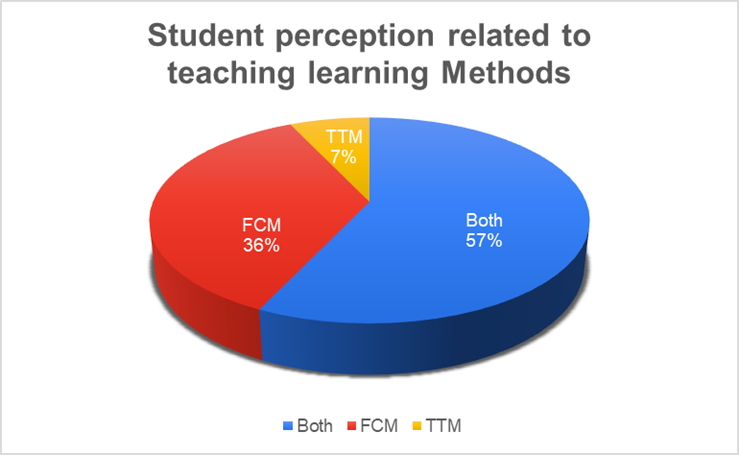
    <heading><span><bold>Introduction</bold></span></heading><p><span>Over the last few years, the application of information and communication technology (ICT) at learning institutions has enhanced learning to greater heights. Technology-enabled learning for the students serves as an adjuvant educational tool to promote learners' knowledge, understanding, and skills<superscript><superscript>[<xref ref-type="link" rid="#ref-1">1</xref>]</superscript></superscript>. Digitalization, especially during the COVID-19 era, has motivated students towards e-learning, spearheaded by ICT's adoption as an interconnecting environment. Over the last few years, many such transformational changes have occurred in the medical education system, and it’s still going on. Many approaches, including different TL methods and models during the transition period, shifted</span></p><div><span> </span></div><p><span>the learning from teacher-centric to student-centric<superscript><superscript>[<xref ref-type="link" rid="#ref-2">2</xref>]</superscript></superscript>. For long, medical education has always been delivered through the traditional method. Over a long period, medical content has been delivered through a teacher lecturing method and a student passively involved in taking information, which is then reviewed later when an assessment is given. Flipping the classroom is the most recent innovative approach to our educational system<superscript><superscript>[<xref ref-type="link" rid="#ref-3">3</xref>]</superscript></superscript>. The flipped classroom model requires students to complete pre-class activities such as watching a video lecture, a short video, listening to a talk or podcast, or reading a journal article. The remaining class time is used to reinforce and connect that knowledge through discussions, interactive exercises, group learning, and case studies <superscript><superscript>[<xref ref-type="link" rid="#ref-4">4</xref>]</superscript></superscript>. The flipped classroom approach has been shown to increase student satisfaction with learning. Learners in flipped classrooms are more satisfied with the ability to access pre-class assignments and learn at their own pace, as well as the increased emphasis on discussions and hands-on activities during class compared to traditional didactic lectures. It is one of the heavily reliant models for student motivation. To make the flipped classroom more effective, students must have</span></p><div><span> </span></div><p><span>either their own intrinsic desire, motivation, or sense of autonomy to complete assignments or extrinsic motivation gained from peer interaction<superscript><superscript>[<xref ref-type="link" rid="#ref-4">4</xref>, <xref ref-type="link" rid="#ref-5">5</xref>]</superscript></superscript>. It has been suggested that a flipped classroom model builds students' motivation with the combination of both intrinsic and extrinsic motivational factors<superscript><superscript>[<xref ref-type="link" rid="#ref-5">5</xref>-<xref ref-type="link" rid="#ref-7">7</xref>]</superscript></superscript>. Switching to a flipped classroom could benefit first-year MBBS students by increasing motivation, peer interaction, and learning new skills. Nowadays, ICT has become part of day-to-day learning. This study aims to evaluate the role of the flipped classroom in realizing sustainable education by using various scientific teaching methods, by using students’ perspectives, and evaluating the outcome and feedback for better learning.</span></p><heading><span><bold>Methodology</bold></span></heading><p><span>Quasi-experimental crossover, an observational type of study, was carried out in the Biochemistry Department, GMERS Medical College, Rajpipla, Dist. Narmada, Gujarat State, within a duration of April-May 2024 (two months). After getting an ethical approval from the Institutional Human Ethics Committee, GMERS Medical College, Rajpipla (<bold>IHECR/GMERSMCR/01</bold>). </span></p><p><span>Written voluntary informed consent was obtained from all participants prior to their enrolment in the study. Participants were clearly informed about the purpose of the study, study procedures, potential benefits, confidentiality of data, and their right to withdraw at any stage without any academic consequences.</span></p><p><span>A Total of 100 first-year MBBS students admitted in the academic year 2023-24 were enrolled based on the following selection criteria-</span></p><p><span><bold>Inclusion criteria: </bold>A total of First-year MBBS students admitted in academic year 2023-24 who willingly consented were in the study. First MBBS students who have attended all the sessions of this study appeared in the written tests and submitted feedback forms.</span></p><p><span><bold>Exclusion criteria:</bold> First-year MBBS students have not shown willingness and consent to participate in the study. Students who have missed any of the activities mentioned in point 2 of the inclusion criteria. Students who remained absent on the day of sessions/tests</span></p><p><span><bold>Study process and data collection: </bold>A total of 100 enrolled students were equally divided with a 1:1 ratio into two groups, i.e., Group A (50 students) and Group B (50 students). No one was absent or missed the session. The clinical concept based on two essential topics from protein metabolism, i.e., Glutathione and one-carbon metabolism, was selected. All the sessions were taken by the same teacher. Pre-test as well as post-test were conducted in a Google Form link shared through Google Classroom. A Pre-test, comprised of 10 multiple-choice questions (MCQs) of recall and extended variety, to test the background knowledge of students regarding topic 1. The total score will be 10 marks, so 1 mark for each MCQ. Similarly, Post post-test was conducted after the session, which consisted of the same MCQs asked during the pre-test, after the completion of each session. </span></p><p><span><bold>First phase of the study with selected topic-1:</bold> In the first period of the study, Group-1 was exposed to the traditional teaching method (TTM), where they were taught topic-1 with the help of a PowerPoint presentation of 1 hour duration. Whereas Group 2 was exposed to the flipped classroom method (FCM). In this, they are provided with pre-study materials of topic-1 in the form of competency, specific learning objectives, and/or a PowerPoint presentation in .pdf format, and a short video recording (15 mins) made on PowerPoint with a voice-over technique. One week of scheduled class. A pre-study material shared with Group-2 students was strictly instructed not to be shared with Group-1 students. To ensure compliance with pre-class activities, home assignments were given to students which has to be completed and brought at the time of in-class activities. During one hour of in-class activities, Group-2 students were divided into five small groups, each comprised of 10 students, to meet the required composition of a small group. 25 minutes provided to interact with peers and topic discussion, followed by objectives and problem-based scenarios, and write conceptual findings on topic 1 at the end. After that, each group leader was given five minutes to present a summary and a question-and-answer session related to topic 1</span></p><p><span><bold>Second phase of the study with selected topic-2: </bold>For topic-2, by applying the crossover design, Group-1 students were exposed to FCM, and Group-2 students were exposed to TTM, and the rest of the procedures are the same as per the first phase of the study.</span></p><p><span><bold>Third phase of the study: </bold>To assess the student perception towards teaching methodology, after completion of both topics and post-tests, feedback from students on a three-point Likert scale (agree, can’t say (Neutral, and disagree) was taken. Anonymity was maintained while taking feedback.</span></p><p><span><bold>Statistical analysis: </bold>All the collected data were entered/exported into an Excel sheet. Marks of written score were represented in the form of mean ± S.D. Frequency or percentage was chosen to represent categorical data. An Independent Paired t-test was used to compare the scores of traditional versus flipped classroom teaching. A p-value of &lt;0.05 was considered statistically significant. The statistical analysis will be done by using SPSS version 20.0. Preparation and validation of PowerPoint presentation and short video recording for both the selected topics, multiple-choice questions (MCQs), and feedback questionnaire were validated by the Delphi method.</span></p><heading><span><bold>Results</bold></span></heading><p><span>The students' ages ranged from 18 to 24 years. Among the 100 enrolled students, 37% were female and 63% were male. Regarding teaching methodologies, students perceived the flipped classroom (FCM-36%) as more beneficial than traditional methods (TTM), with only 7% favouring TTM alone. However, the majority, 57%, expressed a preference for a combination of both FCM and TTM <xref ref-type="link" rid="#figure-1">[Fig. 1]</xref>.</span></p><p> </p><figure><graphic src="https://schoproductionportal.s3.ap-south-1.amazonaws.com/data/JMSH/233/1775203436023.png"/><figcaption><span><bold>Fig. 1</bold></span></figcaption></figure><p> </p><figure id="table-1"><table><thead><tr><th><span><bold>Topics</bold></span></th><th><span><bold>Test</bold></span></th><th><span><bold>Mean ± SD</bold></span></th><th><span><bold>SED</bold></span></th><th><span><bold>t test</bold></span></th><th><span><bold>P value</bold></span></th></tr></thead><tbody><tr><td rowspan="2"><span>Topic-1</span></td><td><span>Pre-test</span></td><td><span>3.4 ± 1.57</span></td><td rowspan="2"><span>0.28</span></td><td rowspan="2"><span>12.9</span></td><td rowspan="2"><span>0.001*</span></td></tr><tr><td><span>Post-test</span></td><td><span>7.1 ± 1.27</span></td></tr><tr><td rowspan="2"><span>Topic-2</span></td><td><span>Pre-test</span></td><td><span>3.8 ± 1.62</span></td><td rowspan="2"><span>0.37</span></td><td rowspan="2"><span>10.0</span></td><td rowspan="2"><span>0.001*</span></td></tr><tr><td><span>Post-test</span></td><td><span>7.3± 2.13</span></td></tr></tbody></table><figcaption><span><bold>Table 1: Comparison of pre- and post-test scores of Group A by Traditional Teaching Methodology (TTM)</bold></span></figcaption></figure><p><italic><span><bold>Significant results at 95% confidence interval and p&lt;0.05, 0.001-statistically significant*</bold></span></italic></p><p><italic><span>SD-Standard Deviation, SED-Standard error of difference</span></italic></p><p> </p><p><span>The mean and SD on 95% class interval (CI) values of pre- and post-test scores obtained by students in traditional and flipped teaching methodology. Although the score of the flipped classroom was higher than the traditional teaching methodology. The comparison showed that the post-test scores were significantly greater than the pre-test scores <xref ref-type="link" rid="#table-1">[Table. 1]</xref>. Overall comparison of pre- and post-test scores (7.1±2.12 and 7.5±2.33) between the two teaching methods in this study has observed better student performance with the FCM teaching technique <xref ref-type="link" rid="#table-2">[Table. 2]</xref>.</span></p><p><span><xref ref-type="link" rid="#table-3">[Table. 3]</xref> depicts the mean difference of pre- &amp; post-test scores among teaching learning methodologies in both groups. However, the mean differences are higher in the flipped teaching methodology. <xref ref-type="link" rid="#table-4">[Table. 4]</xref> presents student perceptions of the teaching methodologies, assessed through a general questionnaire using a 3-point Likert scale. Approximately 86% of students agreed and demonstrated engagement with the flipped classroom model, while 7-9% remained neutral, and around 3-4% disagreed.</span></p><figure id="table-2"><table><thead><tr><th><span><bold>Topics</bold></span></th><th><span><bold>Test</bold></span></th><th><span><bold>Mean ± SD</bold></span></th><th><span><bold>SED</bold></span></th><th><span><bold>t test</bold></span></th><th><span><bold>P value</bold></span></th></tr></thead><tbody><tr><td rowspan="2"><span>Topic-1</span></td><td><span>Pre-test</span></td><td><span>4.2 ± 1.89</span></td><td rowspan="2"><span>0.43</span></td><td rowspan="2"><span>6.49</span></td><td rowspan="2"><span>0.001*</span></td></tr><tr><td><span>Post-test</span></td><td><span>7.0 ± 2.39</span></td></tr><tr><td rowspan="2"><span>Topic-2</span></td><td><span>Pre-test</span></td><td><span>3.6 ± 2.0</span></td><td rowspan="2"><span>0.43</span></td><td rowspan="2"><span>6.72</span></td><td rowspan="2"><span>0.001*</span></td></tr><tr><td><span>Post-test</span></td><td><span>7.2 ± 2.30</span></td></tr></tbody></table><figcaption><span><bold>Table 2: Comparison of pre- and post-test scores of Group B by Flip classroom Teaching Methodology (FCM)</bold></span></figcaption></figure><p><italic><span><bold>Significant results at 95% confidence interval and p&lt;0.05, 0.001-statistically significant*</bold></span></italic></p><p><italic><span>SD-Standard Deviation, SED-Standard error of difference</span></italic></p><p> </p><figure id="table-3"><table><thead><tr><th><span><bold>Topic</bold></span></th><th><p><span><bold>Group</bold></span></p><p><span><bold>(N=100)</bold></span></p></th><th><span><bold>Teaching Methods</bold></span></th><th><span><bold>Mean difference of pre- &amp; post-test scores</bold></span></th><th><span><bold>SED</bold></span></th><th><span><bold>t test</bold></span></th><th><span><bold>P value</bold></span></th></tr></thead><tbody><tr><td rowspan="2"><span>Topic-1</span></td><td><span>A </span></td><td><span>TTM</span></td><td><span>2.7</span></td><td rowspan="2"><span>0.13</span></td><td rowspan="2"><span>6.74</span></td><td rowspan="2"><span>0.01*</span></td></tr><tr><td><span>B </span></td><td><span>FCM</span></td><td><span>3.7</span></td></tr><tr><td rowspan="2"><span>Topic-2</span></td><td><span>A </span></td><td><span>FCM</span></td><td><span>3.9</span></td><td rowspan="2"><span>0.08</span></td><td rowspan="2"><span>10.7</span></td><td rowspan="2"><span>0.01*</span></td></tr><tr><td><span>B </span></td><td><span>TTM</span></td><td><span>2.8</span></td></tr></tbody></table><figcaption><span><bold>Table 3: Comparison of mean difference of pre- and post-test scores in learning methods of both groups</bold></span></figcaption></figure><p><italic><span><bold>Significant results at 95% confidence interval and p&lt;0.05, 0.001-statistically significant*</bold></span></italic></p><p><italic><span>FCM-Flip classroom Methodology, TTM- Traditional Teaching Methodology</span></italic></p><p><italic><span>Total Number of Student = 100, Number in Group-A=50 and Number in Group B=50</span></italic></p><p> </p><heading><span><bold>Discussion</bold></span></heading><p><span>Education is one of the most fundamental requirements for human communities to survive today. Active learning through the use of newer teaching techniques highlights a new curriculum developed by the National Medical Commission (NMC), which transforms students' knowledge into skills and improves their cognitive abilitie<superscript><superscript>[<xref ref-type="link" rid="#ref-8">8</xref>]</superscript></superscript>. The current study involved the classification of assessment questions using Bloom's taxonomy, which took place in two groups with different topics<superscript><superscript>[<xref ref-type="link" rid="#ref-9">9</xref>]</superscript></superscript>.</span></p><div><figure id="table-4"><table><thead><tr><th rowspan="2"><span><bold>Sr. No.</bold></span></th><th rowspan="2"><span><bold>Questionnaire</bold></span></th><th colspan="3"><p><span><bold>Total Number (100)</bold></span></p></th></tr><tr><th><span><bold>Agree</bold></span></th><th><span><bold>Neutral</bold></span></th><th><span><bold>Disagree</bold></span></th></tr></thead><tbody><tr><td><span>1</span></td><td><span>For the flipped classroom method, the pre-class materials helped me understand the concept of the topic clearly.</span></td><td><span>90 (90 %)</span></td><td><span>7 (7%)</span></td><td><span>3 (3%)</span></td></tr><tr><td><span>2</span></td><td><span>I have been provided adequate time for self-directed learning before the in-class session for my preparation</span></td><td><span>88 (88%)</span></td><td><span>10 (10 %)</span></td><td><span>2 (2%)</span></td></tr><tr><td><span>3</span></td><td><span>I felt more responsible for my learning with the flipped classroom method</span></td><td><span>95 (95%)</span></td><td><span>3 (3%)</span></td><td><span>2 (2%)</span></td></tr><tr><td><span>4</span></td><td><span>The flipped classroom method helped me to think critically and apply the knowledge gained.</span></td><td><span>92 (92%) </span></td><td><span>7 (7%)</span></td><td><span>1 (1%)</span></td></tr><tr><td><span>5</span></td><td><span>The flipped classroom method allowed me to adjust the pace and timing according to my convenience.</span></td><td><span>79 (79%)</span></td><td><span>13 (13%)</span></td><td><span>8 (8%)</span></td></tr><tr><td><span>6</span></td><td><span>I have experienced more opportunities to interact with teachers and peers in the flipped classroom method.</span></td><td><span>92 (92%)</span></td><td><span>5 (5%)</span></td><td><span>3 (3%)</span></td></tr><tr><td><span>7</span></td><td><span>The interactive in-class sessions with peers and teacher helped me to acquire skills like communication, leadership, presentation, and problem-solving.</span></td><td><span>88 (88%)</span></td><td><span>9 (9%)</span></td><td><span>3 (3%)</span></td></tr><tr><td><span>8</span></td><td><span>The flipped classroom method enabled me to acquire a habit of being well-preparedness for teaching-learning.</span></td><td><span>89 (89%)</span></td><td><span>6 (6%)</span></td><td><span>5 (5%)</span></td></tr><tr><td><span>9</span></td><td><span>The flipped classroom method helped me in learning through discussion, activities, and projects</span></td><td><span>90 (90%)</span></td><td><span>6 (6%)</span></td><td><span>4 (4%)</span></td></tr><tr><td><span>10</span></td><td><span>I believe that the flipped classroom method should be incorporated for other topics also.</span></td><td><span>96 (81%)</span></td><td><span>4 (4%)</span></td><td><span>0 (0%)</span></td></tr><tr><td><span>11</span></td><td><span>In general, I thoroughly enjoyed and like the flipped classroom method over traditional method.</span></td><td><span>89 (89%)</span></td><td><span>9 (9%)</span></td><td><span>2 (2%)</span></td></tr></tbody></table><figcaption><span><bold>Table 4: Perception of undergraduate medical students towards the flipped classroom learning method</bold></span></figcaption></figure></div><p> </p><p><span>This study emphasized the comparison of the assessment score on the biochemistry topic, i.e., Glutathione and one carbon metabolism, among first MBBS students by using two different teaching methodologies, i.e., traditional teaching model (TTM) and flipped classroom model (FCM). In addition to that, an open-ended feedback perception towards both teaching methods was taken from the participating students.  In recent years, higher education has focused on improving the quality of learning to enhance student engagement and academic performance. The Flipped Classroom Model (FCM) is an interactive teaching approach in which students learn core content before class, while classroom time is used for discussions, problem-solving, and active learning<superscript><superscript>[<xref ref-type="link" rid="#ref-10">10</xref>, <xref ref-type="link" rid="#ref-11">11</xref>]</superscript></superscript>.</span></p><p><span>In laboratory medicine, where analytical skills and practical application are essential for disease management, FCM promotes self-directed learning, critical thinking, and better knowledge retention. The present study aimed to evaluate the effectiveness of FCM in improving student performance and attitudes compared to the traditional lecture-based teaching method<superscript><superscript>[<xref ref-type="link" rid="#ref-12">12</xref>, <xref ref-type="link" rid="#ref-13">13</xref>]</superscript></superscript>. </span></p><p><span>In the present study, the Flipped Classroom (FCR) method significantly improved student performance, especially during the second phase when students were reorganized according to the teaching approach. Analysis of overall assessment scores showed that students taught through FCR performed better than those taught using the traditional lecture-based method. The enhanced performance may be attributed to greater engagement, active participation, and improved conceptual understanding in the flipped model. Overall, the findings suggest that the FCR approach is more effective than conventional teaching in enhancing academic achievement<superscript><superscript>[<xref ref-type="link" rid="#ref-14">14</xref>]</superscript></superscript>.</span></p><p><span>Morton DA </span><italic><span>et al</span></italic><span>.<superscript><superscript>[<xref ref-type="link" rid="#ref-15">15</xref>]</superscript></superscript> reported similar findings in which we compared the performance of two classes of first-year medical students and discovered that FCR benefits students the most in response to content analysis assessments (higher level of cognition), but there was no difference in recall or application-level content. In a traditional teaching method (TTM) class, teachers give a lecture in which students passively receive foundational knowledge, and then they use and apply it outside of the classroom. In traditional teaching methods analysis, students performed better in post-test scores than in pre-test scores. However, the post-test score for the flipped classroom method was neither higher nor lower than the traditional teaching method. Ojennus DD </span><italic><span>et al</span></italic><span>.<superscript><superscript>[<xref ref-type="link" rid="#ref-16">16</xref>]</superscript></superscript> concluded that the learning gains were unaffected, but students expressed strong satisfaction and support for the flipped approach.</span></p><p><span>We observed through feedback that the preferred student perception of teaching learning methods was either a flipped classroom or a mixed/combination of both TTM and FCM. In this context, different medical institution has different opinions on the utility of the two methods.</span></p><p><span> Kuhl SJ </span><italic><span>et al</span></italic><span>.<superscript><superscript>[<xref ref-type="link" rid="#ref-17">17</xref>]</superscript> </superscript>found that medical students prefer the flipped classroom method for biochemistry seminars. Veronica Gillispie<superscript><superscript>[<xref ref-type="link" rid="#ref-18">18</xref>]</superscript></superscript> documented that the flipped classroom approach is more feasible and beneficial to the next generation than the traditional approach. Veeramani R et al. <superscript><superscript>[<xref ref-type="link" rid="#ref-19">19</xref>]</superscript></superscript> given Positive feedback suggests that the flipped method is worth implementing in the future. This study also illustrates that if precise and high-quality study material is provided to students, then there is a high probability of better performance by the students. Similarly, Kuhl SJ </span><italic><span>et al</span></italic><span>.<superscript><superscript>[<xref ref-type="link" rid="#ref-17">17</xref>]</superscript></superscript> have emphasized the importance of high-quality study materials and demonstrated the effectiveness of the flipped classroom in encouraging self-directed learning, which is an essential component of competency-based medical education. The authors compared traditional teaching methods and the authors discovered that flipped classroom approaches significantly improved student-teacher interaction. However, some negative feedback may be due to students' reluctance and anxiety about adopting this new approach. Students may be hesitant to engage with challenging topics for which they lack prior knowledge. These findings are consistent with previous studies<superscript><superscript>[<xref ref-type="link" rid="#ref-20">20</xref>]</superscript></superscript>.  Student perception does not always indicate the most effective method for student learning. There are significant differences between preferred learning formats and actual outcomes <superscript><superscript>[<xref ref-type="link" rid="#ref-21">21</xref>]</superscript></superscript>. This may be due to millennial children have grown up in an entertainment-rich, multimedia environment, and they have a low tolerance for boredom<superscript><superscript>[<xref ref-type="link" rid="#ref-22">22</xref>]</superscript></superscript>. </span></p><p><span>In this study, most students preferred a combination of DL and FCR methods to improve their comprehension and in-depth understanding of topics. This highlights the importance of diversity in the medical school curriculum<superscript><superscript>[<xref ref-type="link" rid="#ref-23">23</xref>]</superscript></superscript>. This emphasizes the importance of incorporating more innovative small group teaching sessions to create a medical education framework that prioritizes learners, patients, and outcomes following National Medical Commission guidelines. Furthermore, there is an increasing emphasis on applying knowledge rather than simply acquiring it. Well-designed FCR sessions are essential for achieving these goals. Our study also reveals the importance of thoughtfully selecting topics for these sessions. To maximize student outcomes, we recommend striking a careful balance between Level 1 (remember and understand) and Level 2 (apply and analyze) topics<superscript><superscript>[<xref ref-type="link" rid="#ref-24">24</xref>]</superscript></superscript>.</span></p><p><span><bold>Challenges and Solutions: </bold>The implemented flipped classroom approach in Biochemistry was not simple and easy, it has associated with certain challenges. Initially, few of students in the class showed resistance to the new learning format due to unfamiliarity with self-directed pre-class preparation, limited access to digital resources and time constraints for both students and faculties.</span></p><p><span>To address these issues, we have conducted an orientation session to make students familiar with the flipped class teaching model. Pre-class materials were designed to be concise, structured, and easily accessible across multiple platforms. Faculty provided continuous guidance, reminders, and conducted structured in-class activities to reinforce accountability. Technical support and flexible access to learning materials were also ensured. Over the time, students have adapted to the approach, resulting in improved participation, better conceptual understanding, and positive feedback.</span></p><p><span><bold>Limitation: </bold>The efficacy of flipped classrooms varies with the subject matter, individual, teaching style, student preferences, course format, and resource availability. So, the findings of one study may not be directly applicable to all disciplines and institutions. </span></p><heading><span><bold>Conclusion</bold></span></heading><list><list-item><p><span>Implementation should be customized to address specific needs and contexts. During the transition phase, a hybrid model that integrates traditional and flipped classroom teaching methods can be employed until these innovative approaches achieve broader acceptance.</span></p></list-item><list-item><p><span>Long-term assessments with multiple topics and disciplines could provide valuable insights into the viability and efficacy of novel teaching methods, such as the flipped classroom technique.</span></p></list-item><list-item><p><span>A successful implementation of the FCM paradigm requires a precise consideration of curriculum design, faculty development, and technological infrastructure, which enhances medical students' learning outcomes, engagement, and critical thinking. </span></p></list-item></list>
  </body>
  <back>
    <ref-list>
      <title>References</title>
      
        
          <ref id="ref-1">
            <element-citation publication-type="journal">
              
                <person-group person-group-type="author">
                  <name>
                    Bishop JL, Verleger MA
                  </name>
                </person-group>
              
              
                <article-title>The Flipped Classroom: A Survey of the Research</article-title>
              
              
                <source>2013 ASEE Annual Conference &amp;amp; Exposition Proceedings</source>


                <uri>https://doi.org/10.18260/1-2--22585</uri>
              
            </element-citation>
          </ref>


          <ref id="ref-4">
            <element-citation publication-type="journal">
              
                <person-group person-group-type="author">
                  <name>
                    Ji M, Luo Z, Feng D, Xiang Y, Xu J
                  </name>
                </person-group>
              
              
                <article-title>Short- and Long-Term Influences of Flipped Classroom Teaching in Physiology Course on Medical Students&#x27; Learning Effectiveness</article-title>
              
              
                <source>Frontiers in Public Health</source>
              
              
                <year>2022</year>
              
              
                <volume>10</volume>


                <uri>https://doi.org/10.3389/fpubh.2022.835810</uri>
              
            </element-citation>
          </ref>


          <ref id="ref-5">
            <element-citation publication-type="journal">
              
                <person-group person-group-type="author">
                  <name>
                    Latorre-Cosculluela C, Suarez C, Quiroga S, Sobradiel N, Lozano-Blasco R, Martinez AR
                  </name>
                </person-group>
              
              
                <article-title>Flipped Classroom model before and during COVID-19: using technology to develop 21st century skills</article-title>
              
              
                <source>Interactive Technology and Smart Education</source>
              
              
                <year>2021</year>
              
              
                <volume>18</volume>
              
              
                <issue>2</issue>
              
              
                <uri>https://doi.org/10.1108/itse-08-2020-0137</uri>
              
            </element-citation>
          </ref>


          <ref id="ref-6">
            <element-citation publication-type="journal">
              
                <person-group person-group-type="author">
                  <name>
                    Phillips J, Wiesbauer F
                  </name>
                </person-group>
              
              
                <article-title>The flipped classroom in medical education: A new standard in teaching</article-title>
              
              
                <source>Trends in Anaesthesia and Critical Care</source>
              
              
                <year>2022</year>
              
              
                <volume>42</volume>


                <uri>https://doi.org/10.1016/j.tacc.2022.01.001</uri>
              
            </element-citation>
          </ref>


          <ref id="ref-7">
            <element-citation publication-type="journal">
              
                <person-group person-group-type="author">
                  <name>
                    Agirman N, Ercoskun MH
                  </name>
                </person-group>
              
              
                <article-title>History of the Flipped Classroom Model and Uses of the Flipped Classroom Concept</article-title>
              
              
                <source>&lt;I&gt;International Journal of Curriculum and Instructional Studies&lt;/I&gt;</source>
              
              
                <year>2022</year>
              
              
                <volume>12</volume>
              
              
                <issue>1</issue>
              
              
                <uri>https://doi.org/10.31704/ijocis.2022.004</uri>
              
            </element-citation>
          </ref>


          <ref id="ref-8">
            <element-citation publication-type="journal">
              
                <person-group person-group-type="author">
                  <name>
                    Baria D, Ramavatarm VSS, Mishra MK, Shah TJ
                  </name>
                </person-group>
              
              
                <article-title>Perception Of Medical Students About Online Mode Discussion By Using Virtual Tools</article-title>
              
              
                <source>Educational Administration: Theory and Practice</source>
              
              
                <year>2024</year>
              
              
                <volume>30</volume>
              
              
                <issue>5</issue>
              
              
                <uri>https://doi.org/10.53555/kuey.v30i5.11483</uri>
              
            </element-citation>
          </ref>


          <ref id="ref-9">
            <element-citation publication-type="journal">
              
                <person-group person-group-type="author">
                  <name>
                    Bhide A, Singh S, Pujitha K, Vani P
                  </name>
                </person-group>
              
              
                <article-title>A study of impact of flipped classroom on student educational experience in comparison with didactic lecture in topics classified based on Bloom’s taxonomy</article-title>
              
              
                <source>Biomedicine</source>
              
              
                <year>2022</year>
              
              
                <volume>42</volume>
              
              
                <issue>1</issue>
              
              
                <uri>https://doi.org/10.51248/.v42i1.660</uri>
              
            </element-citation>
          </ref>


          <ref id="ref-10">
            <element-citation publication-type="journal">
              
                <person-group person-group-type="author">
                  <name>
                    Chen F, Lui AM, Martinelli SM
                  </name>
                </person-group>
              
              
                <article-title>A systematic review of the effectiveness of flipped classrooms in medical education</article-title>
              
              
                <source>Medical Education</source>
              
              
                <year>2017</year>
              
              
                <volume>51</volume>
              
              
                <issue>6</issue>
              
              
                <uri>https://doi.org/10.1111/medu.13272</uri>
              
            </element-citation>
          </ref>


          <ref id="ref-11">
            <element-citation publication-type="journal">
              
                <person-group person-group-type="author">
                  <name>
                    Lage MJ, Platt GJ, Treglia M
                  </name>
                </person-group>
              
              
                <article-title>Inverting the Classroom: A Gateway to Creating an Inclusive Learning Environment</article-title>
              
              
                <source>The Journal of Economic Education</source>
              
              
                <year>2000</year>
              
              
                <volume>31</volume>
              
              
                <issue>1</issue>
              
              
                <uri>https://doi.org/10.1080/00220480009596759</uri>
              
            </element-citation>
          </ref>


          <ref id="ref-12">
            <element-citation publication-type="journal">
              
                <person-group person-group-type="author">
                  <name>
                    Malhotra AS, Bhagat A
                  </name>
                </person-group>
              
              
                <article-title>Flipped classroom for undergraduate medical students in India: are we ready for it?</article-title>
              
              
                <source>Advances in Physiology Education</source>
              
              
                <year>2023</year>
              
              
                <volume>47</volume>
              
              
                <issue>4</issue>
              
              
                <uri>https://doi.org/10.1152/advan.00200.2022</uri>
              
            </element-citation>
          </ref>


          <ref id="ref-13">
            <element-citation publication-type="journal">
              
                <person-group person-group-type="author">
                  <name>
                    Sourg HAA, Satti S, Ahmed N, Ahmed ABM
                  </name>
                </person-group>
              
              
                <article-title>Impact of flipped classroom model in increasing the achievement for medical students</article-title>
              
              
                <source>BMC Medical Education</source>
              
              
                <year>2023</year>
              
              
                <volume>23</volume>
              
              
                <issue>1</issue>
              
              
                <uri>https://doi.org/10.1186/s12909-023-04276-3</uri>
              
            </element-citation>
          </ref>


          <ref id="ref-14">
            <element-citation publication-type="journal">
              
                <person-group person-group-type="author">
                  <name>
                    McLaughlin JE, Roth MT, Glatt DM, Gharkholonarehe N, Davidson CA, Griffin LM, &lt;I&gt;et al&lt;/I&gt;
                  </name>
                </person-group>
              
              
                <article-title>The Flipped Classroom</article-title>
              
              
                <source>Academic Medicine</source>
              
              
                <year>2014</year>
              
              
                <volume>89</volume>
              
              
                <issue>2</issue>
              
              
                <uri>https://doi.org/10.1097/acm.0000000000000086</uri>
              
            </element-citation>
          </ref>


          <ref id="ref-15">
            <element-citation publication-type="journal">
              
                <person-group person-group-type="author">
                  <name>
                    Morton DA, Colbert-Getz JM
                  </name>
                </person-group>
              
              
                <article-title>Measuring the impact of the flipped anatomy classroom: The importance of categorizing an assessment by Bloom&#x27;s taxonomy</article-title>
              
              
                <source>Anatomical Sciences Education</source>
              
              
                <year>2017</year>
              
              
                <volume>10</volume>
              
              
                <issue>2</issue>
              
              
                <uri>https://doi.org/10.1002/ase.1635</uri>
              
            </element-citation>
          </ref>


          <ref id="ref-16">
            <element-citation publication-type="journal">
              
                <person-group person-group-type="author">
                  <name>
                    Ojennus DD
                  </name>
                </person-group>
              
              
                <article-title>Assessment of learning gains in a flipped biochemistry classroom</article-title>
              
              
                <source>Biochemistry and Molecular Biology Education</source>
              
              
                <year>2016</year>
              
              
                <volume>44</volume>
              
              
                <issue>1</issue>
              
              
                <uri>https://doi.org/10.1002/bmb.20926</uri>
              
            </element-citation>
          </ref>


          <ref id="ref-19">
            <element-citation publication-type="journal">
              
                <person-group person-group-type="author">
                  <name>
                    Veeramani R, Madhugiri V, Chand P
                  </name>
                </person-group>
              
              
                <article-title>Perception of MBBS students to &quot;flipped class room&quot; approach in neuroanatomy module</article-title>
              
              
                <source>Anatomy &amp; Cell Biology</source>
              
              
                <year>2015</year>
              
              
                <volume>48</volume>
              
              
                <issue>2</issue>
              
              
                <uri>https://doi.org/10.5115/acb.2015.48.2.138</uri>
              
            </element-citation>
          </ref>


          <ref id="ref-20">
            <element-citation publication-type="journal">
              
                <person-group person-group-type="author">
                  <name>
                    Aggarwal K, Thakur B, Agrawal M, Jhajharia S, Madaan H, Mahapatra SK
                  </name>
                </person-group>
              
              
                <article-title>A comparative study between flipped classroom and traditional lecture-based classroom in first year medical students</article-title>
              
              
                <source>International Journal of Research in Medical Sciences</source>
              
              
                <year>2019</year>
              
              
                <volume>7</volume>
              
              
                <issue>10</issue>
              
              
                <uri>https://doi.org/10.18203/2320-6012.ijrms20194191</uri>
              
            </element-citation>
          </ref>


          <ref id="ref-21">
            <element-citation publication-type="journal">
              
                <person-group person-group-type="author">
                  <name>
                    Pettit RK, McCoy L, Kinney M
                  </name>
                </person-group>
              
              
                <article-title>What millennial medical students say about flipped learning</article-title>
              
              
                <source>Advances in Medical Education and Practice</source>
              
              
                <year>2017</year>
              
              
                <volume>Volume 8</volume>


                <uri>https://doi.org/10.2147/amep.s139569</uri>
              
            </element-citation>
          </ref>


          <ref id="ref-22">
            <element-citation publication-type="journal">
              
                <person-group person-group-type="author">
                  <name>
                    Roehling PV, Kooi TLV, Dykema S, Quisenberry B, Vandlen C
                  </name>
                </person-group>
              
              
                <article-title>Engaging the Millennial Generation in Class Discussions</article-title>
              
              
                <source>College Teaching</source>
              
              
                <year>2010</year>
              
              
                <volume>59</volume>
              
              
                <issue>1</issue>
              
              
                <uri>https://doi.org/10.1080/87567555.2010.484035</uri>
              
            </element-citation>
          </ref>


          <ref id="ref-23">
            <element-citation publication-type="journal">
              
                <person-group person-group-type="author">
                  <name>
                    Lujan HL, DiCarlo SE
                  </name>
                </person-group>
              
              
                <article-title>First-year medical students prefer multiple learning styles</article-title>
              
              
                <source>Advances in Physiology Education</source>
              
              
                <year>2006</year>
              
              
                <volume>30</volume>
              
              
                <issue>1</issue>
              
              
                <uri>https://doi.org/10.1152/advan.00045.2005</uri>
              
            </element-citation>
          </ref>


          <ref id="ref-24">
            <element-citation publication-type="journal">
              
                <person-group person-group-type="author">
                  <name>
                    Ananthakrishnan N
                  </name>
                </person-group>
              
              
                <article-title>Competency based undergraduate curriculum for the Indian Medical Graduate, the new MCI curricular document: Positives and areas of concern</article-title>
              
              
                <source>SBV Journal of Basic, Clinical and Applied Health Science</source>
              
              
                <year>2018</year>
              
              
                <volume>1</volume>
              
              
                <issue>1</issue>
              
              
                <uri>https://doi.org/10.5005/jp-journals-10082-01149</uri>
              
            </element-citation>
          </ref>
        
      
    </ref-list>
  </back>
</article>