Journal of Medical Sciences and Health
DOI: 10.46347/jmsh.v12.i3.25.404
Year: 2026, Volume: 12, Issue: 3, Pages: 274-279
Original Article
Swati Mohapatra 1, J John Magesh Kumar 2, Rajit Kumar 3, Rahul Yadav 4
1Graded Specialist, Department of Anaesthesia and Intensive Care, Military Hospital Bathinda, Punjab, India.
2Associate Professor, Department of Anaesthesia and Intensive Care, Armed Forces Medical College, Pune, India.
3Assistant Professor, Department of Anaesthesia and Critical Care, Command Hospital (SC), Pune, India.
4Professor & Commandant, Military Hospital, Firozpur, Punjab, India.
Received Date:07 December 2025, Accepted Date:13 June 2026, Published Date:19 August 2026

Subarachnoid blockade remains the technique of choice for elective caesarean delivery due to its exceptional predictability, safety profile, and efficacy. The addition of intrathecal opioids, particularly fentanyl, to local anaesthetics enhances both block quality and postoperative analgesia. Despite its widespread adoption, the comparative impact of sequential versus premixed administration of fentanyl with hyperbaric bupivacaine on block onset and haemodynamic outcomes remains unclear. A prospective, parallel-group study was undertaken at a tertiary centre across 18 months, enrolling 100 ASA I–II parturient (18–40 years) for elective caesarean section under subarachnoid block. Participants were randomised to receive either a premixed intrathecal solution of 7.5 mg hyperbaric bupivacaine with 25 µg fentanyl (Group M) or the same doses administered sequentially (Group S). The primary aim was to assess the haemodynamic changes, while the secondary aim was to evaluate the block characteristics and first rescue analgesic. Adverse events were recorded and analysed. Both groups demonstrated comparable baseline characteristics. The premixed group exhibited a higher incidence of early hypotension (33–54% vs. 0–25%, p < 0.05). Sequential administration produced more rapid sensory (3.51 min vs. 4.52 min) and motor block (4.53 min vs. 5.42 min), along with prolonged analgesia (287.48 min vs. 261.04 min, p < 0.05). The incidences of nausea, vomiting, pruritus, and shivering were similar, with no bradycardia or respiratory depression observed. Sequential administration of intrathecal fentanyl with hyperbaric bupivacaine optimises haemodynamic stability, expedites block onset, and extends analgesia relative to premixed administration for caesarean section anaesthesia.
The subarachnoid block is a preferred anaesthetic technique for conducting a caesarean section because of its exceptional predictability, safety profile, simplicity, cost-effectiveness, and high level of patient acceptability[1]. Intrathecal administration of local anaesthetics, such as hyperbaric bupivacaine or levobupivacaine, provides dense surgical anaesthesia and ensures adequate pain relief during caesarean section, through sympathetic neuraxial blockade[2]. To augment the block characteristics, various adjuvants, such as opioids and α2-agonists, are combined with local anaesthetics. Intrathecal fentanyl is frequently used as
an adjuvant; its high lipid solubility facilitates rapid onset, enhances the quality of neuraxial blockade, and provides superior postoperative pain relief[3].
The intrathecal distribution of drugs affects sensory and motor levels during neuraxial blockade. Higher cranial spread of drug combinations is associated with adverse events such as hypotension, high spinal block, and, in rare cases, total spinal block with cardiovascular compromise. Drug-related factors, such as pH, temperature, and baricity, influence intrathecal spread. Patient positioning also plays a role in intrathecal spread[4]. Adding adjuvants, such as fentanyl, to local anaesthetics can change the baricity of the solution. This change in baricity can alter the intrathecal distribution of the drug and the extent of the neuraxial blockade achieved[5].
The current literature has conflicting evidence regarding how premixed versus sequential intrathecal administration of fentanyl and hyperbaric bupivacaine influences drug spread and block characteristics[6, 7]. To
address this ambiguity, this parallel-group comparative study was designed to evaluate how these two administration techniques impact neuraxial blockade in parturients undergoing elective caesarean delivery. The primary aim was to assess haemodynamic variations, whereas the secondary aim was to evaluate block characteristics and the duration of the first rescue analgesia following surgery.
This parallel-group comparative study was conducted over an 18-month period (July 2022 to June 2023) at a tertiary care centre in western India. Ethical approval was obtained from the Institutional Ethics Committee (IEC/ANAES/01/2022 dated 03 October 2022), and written informed consent was obtained from all participants.
A total of 100 parturients aged 18–40 years with American Society of Anesthesiologists (ASA) physical status II, scheduled for elective caesarean section under spinal anaesthesia, were recruited. The exclusion criteria were emergency lower-segment caesarean section, refusal to participate, spinal deformities, coagulopathy, active local infection, and known hypersensitivity to hyperbaric bupivacaine or fentanyl.
Participants were randomised into two groups using a computer-generated allocation chart based on their unique admission numbers. Group M received 2 ml of a premixed solution of hyperbaric bupivacaine (1.5 ml) and 0.5 ml fentanyl (25µg). Group S received 1.5 ml of hyperbaric bupivacaine followed by 0.5 ml of fentanyl (25µg) sequentially. The participants were unaware of their group allocations. Anaesthesiologists involved in the procedure were not blinded to manage adverse reactions. However, those who gathered data and evaluated outcomes were unaware of the group assignments.
The sample size was determined based on the findings of Chekole et al.[8] and was further refined through institutional discussions. The calculation aimed to detect a difference in the onset of hypotension between two groups: one receiving a premixed solution of hyperbaric bupivacaine with fentanyl and the other receiving hyperbaric bupivacaine followed by fentanyl sequentially during spinal anaesthesia. Assuming equal group allocation (1:1), with a statistical power of 80% and a significance level of α = 0.05, the sample size was calculated using OpenEpi version 3 (www.OpenEpi.com) [9]. To account for the expected attrition rate of 10%, we recruited a total of 100 pregnant patients.
All participants received anaesthetic management in accordance with institutional protocols. Each patient underwent a preoperative anaesthesia evaluation prior to surgery. In the operating room, standard ASA monitoring such as non-invasive blood pressure, pulse oximetry, and electrocardiograph were attached, and baseline vital parameters were documented. All patients received a co-load of 1000 ml crystalloid solution during the procedure.
The attending anaesthesiologist administered spinal anaesthesia under aseptic precautions with 25G Quincke spinal needle in the sitting position using either the sequential or premixed technique. In the sequential group (S group), parturients received 7.5 mg of 0.5% hyperbaric bupivacaine, followed by 25 μg of fentanyl. In the premixed group (M group), 7.5 mg of 0.5% hyperbaric bupivacaine premixed with 25 μg of fentanyl in a syringe was injected intrathecally. Immediately after the subarachnoid block, the patients were positioned supine with a 15° left lateral tilt.
Sensory block onset and the highest dermatomal level achieved were assessed using the loss of cold sensation, whereas motor block was assessed using the modified Bromage scale. The onset and duration of sensory and motor blockade were recorded at 2, 5, 10, 15, and 30 minutes, and at 1, 2, and 3 hours. The haemodynamic parameters were continuously monitored and documented. Adverse events, such as hypotension and bradycardia, were documented and managed according to standard protocols.
Hypotension was defined as a reduction of 20% from baseline measurement or a systolic blood pressure below 100 mmHg[10]. Bradycardia was defined as a heart rate below 60 beats per minute during a single or multiple observations[11]. Respiratory depression was characterized by a respiratory rate below 10 breaths per minute or an oxygen saturation level below 90%[10]. Pruritus: any scratching or itching reported by the patient or an observable rash following the subarachnoid block[8]. Nausea is an unpleasant feeling associated with the urge to vomit[12]. The sensory block onset was defined as the time taken for the loss of pinprick or cold sensation at the T10 dermatome after spinal injection[8]. The time to the first analgesic was defined as the duration in minutes from the administration of spinal anaesthesia to the patient’s request for analgesics[8]. Modified Bromage scale: 0: No motor block, 1: Inability to raise extended leg; able to move knees and feet, 2: Inability to raise extended leg and move knee; able to move feet, 3: Complete block of motor limb[13].
Data were entered into Microsoft Excel and subsequently analysed using SPSS version 26.0 (IBM Corp., Armonk, NY, USA). Categorical variables were expressed as frequencies and percentages, whereas continuous variables were expressed as medians and interquartile ranges (IQR). The Kolmogorov–Smirnov test was employed to evaluate normality and revealed that the continuous variables did not follow a normal distribution. Consequently, intergroup comparisons were conducted using the Mann–Whitney U test for continuous variables and the Chi-square test for categorical variables. A p-value of less than 0.05 was considered statistically significant. Results were depicted using appropriate graphical methods.
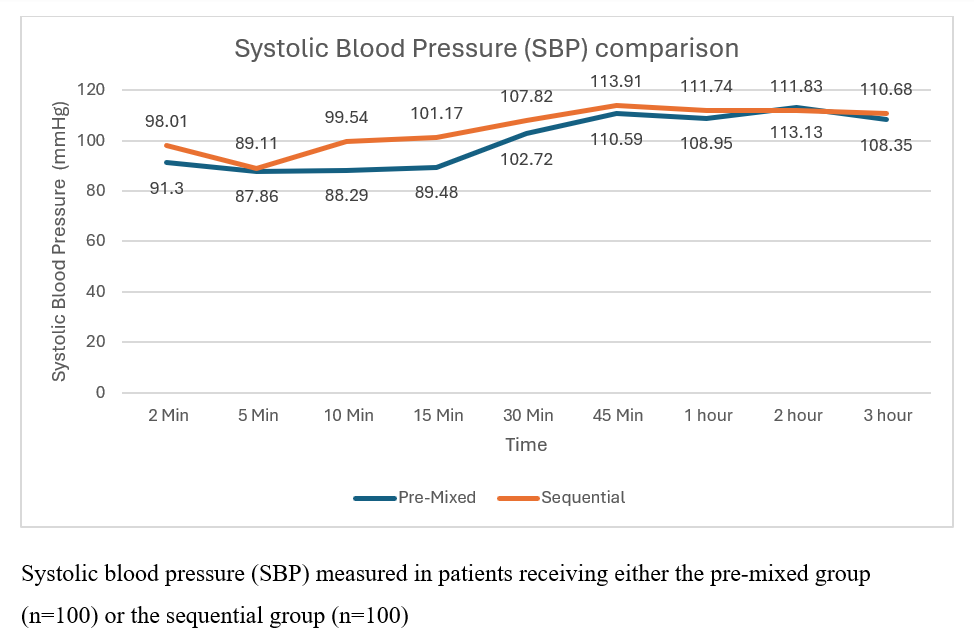
The demographic characteristics and baseline vital parameters of the patients in both groups were comparable, as shown in [Table. 1]. The premixed group showed a statistically significant reduction in systolic blood pressure (SBP) compared to the sequential group at 2, 10, 15, 30, 45, and 60 minutes after spinal anaesthesia (p < 0.05). The two groups did not show any statistically significant difference in systolic blood pressure (SBP) at 2 and 3 hours post-procedure (p > 0.05). However, the incidence of hypotension was notably higher in the premixed group (54–33%) at 2, 10, and 15 min following spinal anaesthesia compared to the sequential group (0–25%) [Fig. 1].
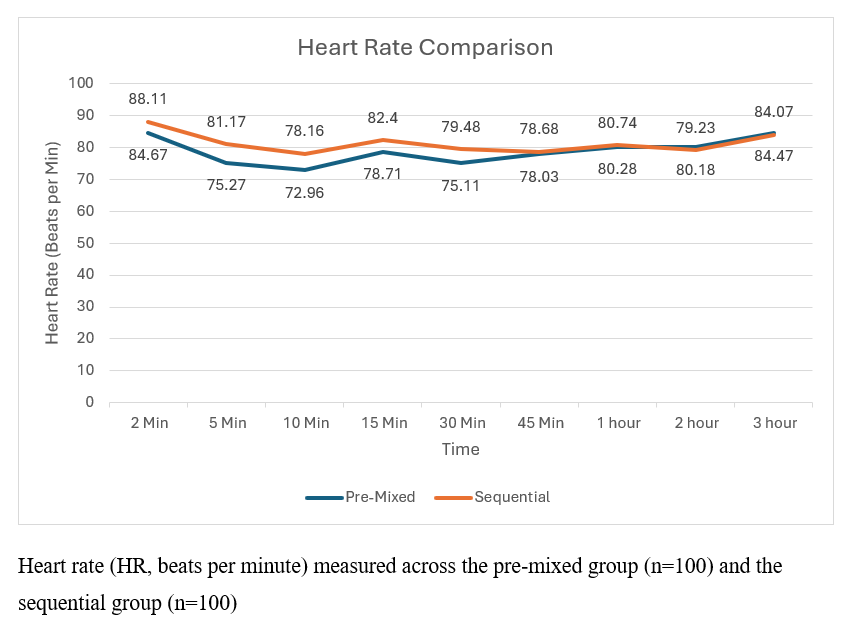
A statistically significant difference in the mean intraoperative heart rate was observed between the two groups at baseline and at 2, 5, 10, 15, and 30 min following spinal anaesthesia (p < 0.05). However, no significant intergroup variation was noted during the postoperative period at 45 min, 1 h, 2 h, and 3 h (p > 0.005) [Fig. 2]. In the premixed group, the mean onset time of the sensory block was 4.52 min, whereas in the sequential group, it was 3.51 min. The mean onset time of motor block was 5.42 min in the premixed group, whereas it was 4.53 min in the sequential group. The time to first rescue analgesic was 261.04 min in the premixed group and 287.48 min in the sequential group [Table. 2].
The sequential group exhibited a significantly shorter onset of sensory and motor block compared to the premixed group (p < 0.05). Conversely, the sequential group showed a significantly longer duration before the need for the first rescue analgesia compared to the premixed group (p < 0.05) [Table. 2].
|
Premixed (n=100) |
Sequential (n=100) |
|||||||
|---|---|---|---|---|---|---|---|---|
| Variable | Mean | Median | SD | IQR | Mean | Median | SD | IQR |
| Age (years) | 28.67 | 29.0 | 6.29 | 23.25–34 | 28.85 | 29.0 | 6.94 | 22.25–35 |
| Weight (kg) | 70.07 | 69.5 | 14.05 | 58.25–81.75 | 70.28 | 70.0 | 12.69 | 60–79.75 |
| Height (cm) | 160.39 | 161.0 | 8.48 | 153–167 | 160.06 | 160.0 | 8.53 | 153–167 |
| BMI | 27.23 | 27.78 | 4.99 | 22.21–30.75 | 27.46 | 27.87 | 4.58 | 25.12–30.02 |
| HR (bpm) | 90.82 | 93.0 | 12.45 | 79–101.75 | 88.96 | 90.0 | 11.97 | 77.25–100 |
| SBP (mmHg) | 113.51 | 113.5 | 8.66 | 106–121.75 | 112.26 | 112.0 | 9.09 | 105–119.75 |
| MAP (mmHg) | 71.42 | 71.0 | 3.96 | 68–75 | 71.38 | 71.0 | 3.63 | 69–75 |
| SpO₂ (%) | 97.04 | 97.0 | 1.46 | 96–98 | 96.9 | 97.0 | 1.47 | 95–98 |
Data are presented as mean, median, standard deviation (SD), and interquartile range (IQR). BMI = body mass index; HR = heart rate; SBP = systolic blood pressure; MAP = mean arterial pressure; SpO₂ = peripheral oxygen saturation. IQR presented as lower–upper quartile values (25th-75th percentiles)
The incidence of hypotension was markedly higher in the premixed group (33–54%) at 2, 10, and 15 min following spinal anaesthesia than that in the sequential group (0–25%). The prevalence of nausea, vomiting, shivering, and pruritus was similar between the two groups (p > 0.05). Neither group exhibited bradycardia or respiratory depression.
| Parameter | Group | Mean ± SD | Median (IQR) |
|---|---|---|---|
| Onset of sensory block (min) |
Pre-mixed | 4.52 ± 0.50 | 5.00 (4–5) |
| Sequential | 3.51 ± 0.50 | 4.00 (3–4) | |
| Onset of motor block (min) |
Pre-mixed | 5.42 ± 0.50 | 5.00 (5–6) |
| Sequential | 4.53 ± 0.50 | 5.00 (4–5) | |
| Time to first rescue analgesia (min) |
Pre-mixed | 261.0 ± 13.7 | 261.0 (249–271) |
| Sequential | 287.5 ± 8.9 | 288.5 (279–295) |
Data are expressed as mean ± standard deviation (SD) and median (interquartile range, IQR). Onset times for sensory and motor blockades are measured in minutes (min) from the exact time of intrathecal injection to the achievement of the respective block level. Time to first rescue analgesia is defined as the duration (in minutes) from spinal drug administration to the patient's first requirement for supplemental analgesic medication.
|
Ranks |
|||||
|---|---|---|---|---|---|
| Group | N | Mean Rank | Sum of Ranks | p value | |
| Onset of sensory block (min) |
Pre-mixed | 100 | 138.26 | 13826.00 | <0.001 |
| Sequential | 100 | 62.74 | 6274.00 | ||
| Total | 200 | ||||
| Onset of motor block (min) |
Pre-mixed | 100 | 135.13 | 13513.00 | <0.001 |
| Sequential | 100 | 65.87 | 6587.00 | ||
| Total | 200 | ||||
| First rescue analgesic (min) |
Pre-mixed | 100 | 56.04 | 5604.00 | <0.001 |
| Sequential | 100 | 144.96 | 14496.00 | ||
| Total | 200 | ||||
Data are presented as sample size (N=200), Mean Rank, and Sum of Ranks. Statistical comparisons were performed using the Mann–Whitney U test. A p<0.05 is considered statistically significant. Onset times and rescue analgesia durations are measured in minutes (min) from the time of intrathecal spinal administration. Abbreviations: N, number of patients; p value, probability value.
This parallel-group comparative study evaluated the effects of sequential versus premixed intrathecal administration of fentanyl combined with hyperbaric bupivacaine on intraoperative and immediate postoperative outcomes in parturients undergoing elective caesarean section. In our study, during the first 15 minutes after subarachnoid block the incidence of hypotension was significantly higher in the premixed group (33–54%) in comparison to the sequential group (0–24%). No episodes of hypotension were observed in either group beyond 30 min in the perioperative period. These findings were consistent with previous reports[8, 14, 15]. The initial incidence of hypotension observed in the premixed group was possibly attributed to alterations in the baricity of the drug mixture, making it more hypobaric. This hypobaric combination of bupivacaine and fentanyl could have led to more extensive cephalad distribution in the subarachnoid space, leading to a higher level of sympathetic blockade and triggering a more profound hypotensive response. Approximately 15 minutes after injection, intrathecal local anaesthetics fixes to neural tissues, which likely accounts for the declining incidence of new-onset hypotension later in the perioperative period. In the sequential administration group, the baricity of the hyperbaric bupivacaine remains unaltered as both the drugs are injected separately. This allows the local anaesthetic to settle rapidly within the dependent lumbar lordosis under the influence of gravity, restricting extensive cephalad migration before fixation occurs[14, 15].
Similarly, no statistically significant differences in heart rate were observed between the two groups, this finding closely aligns with previous studies. This stability in heart rate is best explained by the absence of high thoracic sympathetic blockade, preserving the integrity of the cardioaccelerator fibres (T1–T4) in both groups[8].
In the present study, the sequential group exhibited a significantly shorter onset time for both sensory and motor block compared to the premixed group. These findings align with earlier reports that demonstrated a shorter onset in patients receiving sequential administration[2, 8, 15-17]. The difference can be better understood by considering the dynamics of intrathecal drug distribution. Following subarachnoid block, a hyperbaric solution tends to descend under the influence of gravity, pooling predictably within the dependent curvature of lumbar lordosis. In contrast, when fentanyl is premixed with hyperbaric bupivacaine, the final solution becomes hypobaric because of dilution. This hypobaric solution spreads more uniformly within the cerebrospinal fluid (CSF) than settling rapidly, leading to a delay in the onset of a dense block[18].
In the present study, the time to first rescue analgesia was significantly longer in the sequential group (287.48 min) than in the premixed group (261.04 min). Similar findings have been reported in earlier studies, which consistently demonstrated prolonged analgesia with sequential administration compared to premixed administration[2, 6, 9, 19-21]. A possible explanation is that premixing fentanyl with bupivacaine may dilute the opioid concentration at the receptor level, diminishing its receptor binding efficiency, thereby reducing its analgesic effect. In contrast, when fentanyl is administered sequentially, it likely interacts effectively at high concentrations with opioid receptors in the spinal cord, resulting in a denser block and extended duration of postoperative analgesia[20].
Other perioperative adverse events, such as pruritus, shivering, nausea, and vomiting, were observed in both groups, but the differences were not statistically significant. No cases of respiratory depression or bradycardia were recorded in either group. These findings are consistent with those reported in previous randomised controlled trials, further supporting the safety profile of both approaches.
This study had several strengths. This was a prospective, adequately powered, parallel comparative study with a well-defined methodology. Randomisation helped minimise selection bias, while strict blinding of both the patients and data collectors mitigated subjective reporting errors. The study population was homogenous (ASA II) parturients undergoing elective caesarean sections, limiting potential confounders. Additionally, both haemodynamic changes and block characteristics were systematically assessed to ensure clinically meaningful observations[8, 11, 14, 15].
However, this study has certain limitations. Being a single-centre study, the external validity and generalisability of findings to more diverse patient populations can be a constrain. The baseline temperature of the medications, a variable which can influence the baricity and spread of the drug, was not considered. The blinding of anaesthesiologists to the type of drug preparation was not feasible, which may have introduced information bias. Finally, factors such as the speed of intrathecal injection and the use of the barbotage technique were not standardised among practitioners which may have introduced minor variations in the haemodynamic responses.
The sequential administration of intrathecal fentanyl with hyperbaric bupivacaine provides better haemo- dynamic stability than the premixed technique in women undergoing caesarean section. This approach was associated with a reduced incidence of intraoperative hypotension, shorter onset time for sensory and motor block, and prolonged duration of postoperative analgesia. These findings indicate that the sequential method has distinct clinical advantages in improving maternal safety during scheduled caesarean sections.
Larger multicentre trials with standardised drug preparation and injection protocols are warranted to validate these findings and enhance their external validity. Future studies should also explore the influence of drug temperature, barbotage, and injection speed on the intrathecal drug distribution. Additionally, evaluating neonatal outcomes and long-term maternal recovery would provide a more holistic and comprehensive understanding of the clinical utility of this sequential technique.
Swati Mohapatra: This author contributed to the design of the study, literature search, data acquisition, data analysis, writing the original draft, critical review of the manuscript and approval of the manuscript.
J John Magesh Kumar: This author contributed to the design and supervision of the study, literature search, data interpretation, critical review and final approval of the manuscript.
Rajit Kumar: This author contributed to the data analysis, data interpretation and final approval of the manuscript.
Rahul Yadav: This author contributed to the critical review and final approval of the manuscript.
1. Rates of caesarean section: analysis of global, regional and national estimates. Paediatric and Perinatal Epidemiology. 2007; 21 (2). Available from: https://doi.org/10.1111/j.1365-3016.2007.00786.x
2. Efficacy of premixed versus succedent administration of fentanyl and bupivacaine in subarachnoid block for lower limb surgeries: A randomised control trial. Indian Journal of Anaesthesia. 2020; 64 (15). Available from: https://doi.org/10.4103/ija.ija_264_20
3. Healy TJ, Knight PR. Wylie and Churchill-Davidson’s A Practice of Anesthesia. London: Arnold Press; 2003.
4. Distribution of Local Anesthetic Solutions within the Subarachnoid Space. Anesthesia & Analgesia. 1985; 64 (7). Available from: https://doi.org/10.1213/00000539-198507000-00012
5. Assessment of the Densities of Local Anesthetics and Their Combination with Adjuvants. An Experimental Study. Brazilian Journal of Anesthesiology. 2009; 59 (2). Available from: https://doi.org/10.1590/s0034-70942009000200003
6. A Randomised Controlled Trial of Hyperbaric Bupivacaine with Opioids, Injected as Either a Mixture or Sequentially, for Spinal Anaesthesia for Caesarean Section. Anaesthesia and Intensive Care. 2010; 38 (2). Available from: https://doi.org/10.1177/0310057x1003800209
7. Efficacy of premixed versus sequential administration of dexmedetomidine as an adjuvant to intrathecal hyperbaric bupivacaine in lower limb surgery. Southern African Journal of Anaesthesia and Analgesia. 2016; 22 (3). Available from: https://doi.org/10.1080/22201181.2016.1179468
8. Comparison of sequential versus pre mixed administration of intrathecal fentanyl with hyperbaric bupivacaine for patients undergoing elective Caesarean section at Zewditu memorial referral hospital: A prospective cohort study. Annals of Medicine & Surgery. 2022; 74 Available from: https://doi.org/10.1016/j.amsu.2022.103313
9. OpenEpi Epidemiologic Statistics [Internet]. Openepi.com. 2026 [cited 2026 May 24]. Available from: https://openepi.com
10. Definitions of hypotension after spinal anaesthesia for caesarean section: literature search and application to parturients. Acta Anaesthesiologica Scandinavica. 2010; 54 (8). Available from: https://doi.org/10.1111/j.1399-6576.2010.02239.x
11. Efficacy of premixed versus succedent administration of fentanyl and bupivacaine in subarachnoid block for lower limb surgeries: A randomised control trial. Indian Journal of Anaesthesia. 2020; 64 (15). Available from: https://doi.org/10.4103/ija.ija_264_20
12. Postoperative nausea and vomiting. Anaesthesia & Intensive Care Medicine. 2018; 19 (9). Available from: https://doi.org/10.1016/j.mpaic.2018.06.009
13. Spinal anaesthesia: comparison of plain ropivacaine 5 mg ml-1 with bupivacaine 5 mg ml-1 for major orthopaedic surgery. British Journal of Anaesthesia. 2002; 89 (5). Available from: https://doi.org/10.1093/bja/89.5.702
14. Two syringe spinal anesthesia technique for cesarean section: A controlled randomized study of a simple way to achieve more satisfactory block and less hypotension. Anesthesia: Essays and Researches. 2016; 10 (2). Available from: https://doi.org/10.4103/0259-1162.171447
15. Intrathecal Administration of Fentanyl with Hyperbaric Bupivacaine either a Mixture or Sequentially in Elective Cesarean Section: A Randomised Single Blind Study. Journal of Clinical and Diagnostic Research. 2020; 14 Available from: https://doi.org/10.7860/jcdr/2020/43916.13753
16. Randomized controlled study comparing the efficacy of neuraxial blockade by using intrathecal administration of 0.5% hyperbaric bupivacaine 15mg and fentanyl 25mcg - in a single syringe versus separate syringe techniques in inguinal hernia surgeries. Indian Journal of Clinical Anaesthesia. 2020; 7 (3). Available from: https://doi.org/10.18231/j.ijca.2020.072
17. Sequential intrathecal injection of fentanyl and hyperbaric bupivacaine at different rates: does it make a difference? A randomized controlled trial. Korean Journal of Anesthesiology. 2019; 72 (2). Available from: https://doi.org/10.4097/kja.d.18.00173
18. Srivastava U, Kumar A, Gandhi NK, Saxena S, Dutta D, Chandra P, et al. Hyperbaric or plane bupivacaine combined with fentanyl for spinal anaesthesia during caesarean delivery. Indian Journal of Anaesthesia. 2004;48(1):446.
19. Premixed versus sequential administration of intrathecal fentanyl as a bupivacaine adjuvant in lower limb orthopedic surgeries: a prospective randomized controlled study. Mansoura Medical Journal. 2016; 46 (1). Available from: https://doi.org/10.21608/mjmu.2016.124256
20. Intrathecal clonidine with hyperbaric bupivacaine administered as a mixture and sequentially in caesarean section: A randomised controlled study. Indian Journal of Anaesthesia. 2014; 58 (3). Available from: https://doi.org/10.4103/0019-5049.135039
21. Sharma SK, Sehera H, Sharma M. Comparison of premixed and sequential intrathecal administration of clonidine with hyperbaric bupivacaine in caesarean section. International Multispeciality Journal of Health. 2015;13:20–4.
Subscribe now for latest articles and news.