Journal of Medical Sciences and Health
DOI: 10.46347/jmsh.v12.i2.25.420
Year: 2026, Volume: 12, Issue: 2, Pages: 146-149
Original Article
Paul Mathew1, Mangala Rao 1, Suma Jayaram1
1Department of Pharmacology, St John’s Medical College and Hospital, Bangalore, Karnataka, India.
Address for correspondence: Mangala Rao, Department of Pharmacology, St John’s Medical College and Hospital, Bangalore, Karnataka, India.
E-mail: [email protected]
Received Date:23 December 2025, Accepted Date:07 April 2026, Published Date:18 May 2026
Team-based learning (TBL) was used as a teaching-learning method to improve student learning. We got feedback from students and faculty to help us implement more TBL sessions with improvements if necessary.
Methods: 10 teams of 15 students. Individual Readiness Assurance Test (iRAT) and Team Readiness Assurance Test (tRAT) (15 MCQs) were conducted and two case scenarios were then discussed. Feedback and perceptions were obtained from students and faculty.
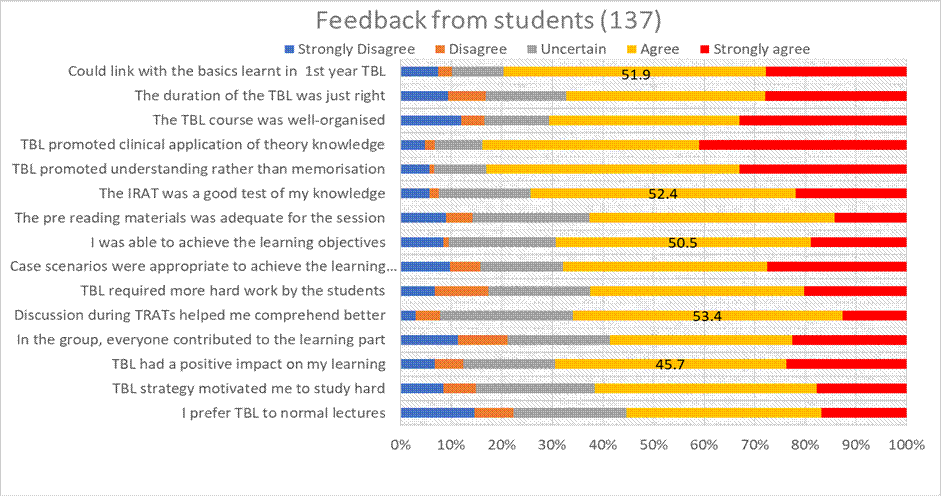
Results: 137 responses from students and 15 perceptions from faculty. Mean + SD iRAT and tRAT scores were 8.4 +2.2 and 11.8 + 1.39 respectively. Feedback form for students was divided into 5 sections which included motivation, teamwork, learning objective, content and facilitation of learning. Highest score of 53.4% was obtained for “Discussion during tRATs helped me comprehend better”, followed by “iRAT was a good test of my knowledge” 52.4%. Seventeen percent mentioned that they needed more case scenarios and 6.8% mentioned that the session should have been shorter.
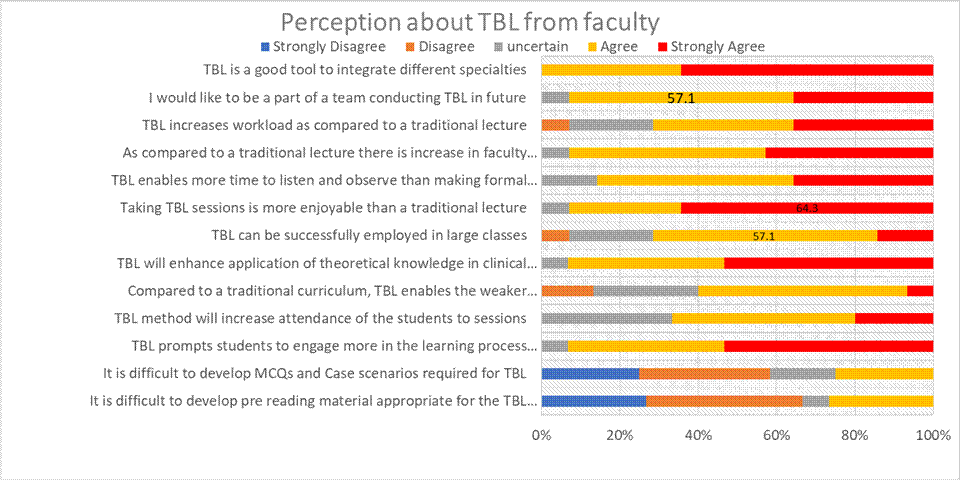
Perception from faculty: 66.7% of the faculty felt there was no difficulty in developing pre reading materials. 42.8% mentioned time and availability of faculty from different departments was the challenge.
Conclusion: Students felt TBL helped them integrate the concept of a disease across specialities and faculty found it more enjoyable to take a TBL session as compared to a traditional lecture.
Team-based learning (TBL) is defined as “an active learning and small group instructional strategy that provides students with opportunities to apply conceptual knowledge through a sequence of activities that includes individual work, teamwork, and immediate feedback”[1]. This can be applied in large classes.
In the year 1980 Prof. Larry Michaelsen from USA started the concept of team-based learning for the students in business schools. But it took time to make it to the medical profession. In the year 2012 it was Haidet and colleagues who brought this novel idea of team-based learning into a structured format and implemented it[1]. It is mainly based on application of theoretical knowledge in a practical situation.
It involves individual prior student preparation, individual and team readiness assurance tests (iRAT)(tRATs) and the majority of in-class time devoted to application of theory knowledge in problem solving (clinical scenario based) in a team[2].
An integrated session on Ischaemic Heart Disease (IHD) was conducted in the Department of Pharmacology in association with the departments of pathology and General Medicine using TBL as the teaching-learning method. We collected feedback from students and faculty about their perceptions regarding TBL. The results of this feedback would help us implement more TBL sessions and improve the process if necessary.
This was a cross-sectional questionnaire-based study. Institutional Ethics Committee approval was obtained for this study (IEC Code no. 328/2021). TBL session was conducted for 2nd year MBBS students. Informed consent was obtained from the students and faculty before the study. All consenting students attending the TBL session were included in the study. All faculty who were involved in developing the material and the conduct of the TBL were included for obtaining the perceptions.
Students’ questionnaire
The feedback form for students contained 5 domains with a total of 15 items. This included motivation, teamwork, learning objective, content and facilitation of learning. Responses were recorded on a five-point Likert scale (1–5), where 1 represented strongly disagree and 5 represented strongly agree. It also included “suggestions to improve the session” and “facilitating factors and challenges to the conduct of TBL session” as open ended questions for students and faculty respectively.
The questions for the questionnaire were framed based on other studies involving TBL as teaching learning method[3, 4]. The draft questionnaire was reviewed by 3 subject experts (Medical educators who have experience with TBL) for clarity, relevance and comprehensiveness. Then the questionnaire was piloted among 15 students (not part of the study participants) to assess clarity, non-ambiguity and time taken to complete the form.
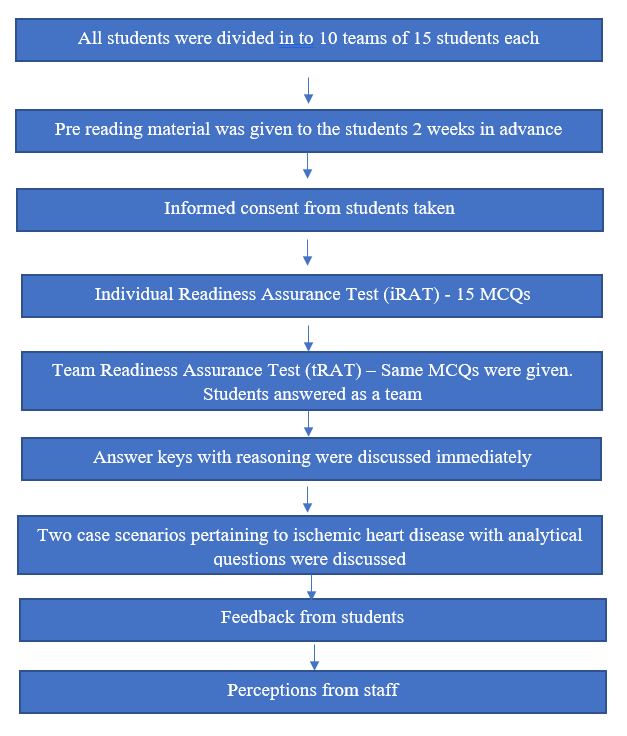
The steps of TBL were as follows:
Statistical Analysis
Descriptive statistics was used to analyse the data. Feedback from students and perceptions from faculty with regards to use of TBL as a teaching learning method were summarized descriptively. Inductive (Data-driven) thematic analysis was conducted for the responses to open ended questions.
One hundred and thirty-seven students were present on the day of the session. Not more than 2 students were missing in each of the preassigned teams. We received 137 responses from students and 15 perceptions from faculty. Response rate from students was 100%. The mean + SD iRAT and tRAT scores were 8.4 + 2.2 and 11.8 + 1.39 respectively.
Students’ questionnaire
[Fig. 1] displays the student responses to questions regarding their TBL experience. [Table. 1] summarizes the answers to open ended questions regarding TBL. Around fifty three percent [53.4% (73/137)] of the students agreed/strongly agreed that discussion during the session helped them to comprehend better. Fifty three percent (72/137) and 51.9 % (71/137) of students agreed/strongly agreed that attempting the questions for iRAT scores was a good assessment of their knowledge and they could link with the basics learnt in 1st year TBL respectively. 84% (97/116) of students said TBL session helped them to integrate the concepts of IHD across specialties. We received 29 suggestions for improvement. Seventeen percent (5/29) mentioned that they needed more case scenarios [Table. 1].
| Sl No. | Theme | Code | Sample of Actual response |
|---|---|---|---|
| 1 | Enhanced student engagement | Positive learning environment | “It was very educational and fun. Could work on teamwork skills as well” |
| 2 | Deeper learning through case scenarios | Need for more cases in the session | “More case scenarios would be nice” |
| 3 | Technical barriers | Audio disturbance | “Audio could have been better” |
| Sl No. | Theme | Code | Sample of Actual response |
|---|---|---|---|
|
Facilitating Factors |
|||
| 1 | Curriculum | Requirement for integrated sessions in the curriculum | “Increasing requirement of TBL sessions as per curriculum and considering sessions as part of traditional teaching hours for all departments involved” |
| 2 | Infrastructure | Availability of infrastructure | “Availability of classrooms, audio visual aids make it easier to conduct TBL” |
| 3 | Faculty training | Faculty development programmes to train faculty | “training/orientation among faculty for the conduct of TBL” |
| 4 | Interest | Enthusiastic faculty and students | “Active student and teacher participation” |
|
Challenges to implementation of TBL |
|||
| 1 |
Time constraints
|
Increased faculty overload | “Time available to faculty” |
| 2 | Lack of pre session preparation by students | Students not studying the assigned topics | “Inattention and lack of discipline in students” |
Perception from faculty
Fifty three percent (8/15) of faculty who responded were part of a team which developed the content for the TBL session. Faculty gave their perceptions about the content and process of TBL. Majority (66.7% -10/15) of the faculty felt there was no difficulty in developing the pre reading materials. Around 60% (9/15) of faculty strongly agreed that taking TBL sessions was more enjoyable than a traditional lecture, and 57.1 % (8/15) agreed that they liked to be a part of a team conducting TBL in future and TBL can be successfully employed in large classes [Fig. 2]. Thirteen faculty responded to the question about facilitating factors out of which 23% (3/13) felt active participation of students and faculty as the facilitating factor for TBL. Time and availability of faculty from different departments was the challenge to the conduct more TBL sessions stated by 42.8% (6/14) of faculty [Table. 2].
Team based learning (TBL) is a novel teaching learning method which is used only in some institutions in medical education. It aims to improve active learning among the students. TBL increases the student participation and helps them to integrate the different subjects as a whole rather than learning it as different entities. The TBL session conducted was part of a linker session. There was a TBL session on myocardial infarction in Phase 1. This session was designed as a continuation of the session in Phase 1. Linker sessions are mandatory as per CBME curriculum.
Previous studies which looked at perceptions of students in TBL have found that around 78.4% students felt they had more understanding of topic rather than memorizing & 67.2% felt they could apply the knowledge clinically[5]. Our study showed a more favorable response to TBL, 83% of students responded that they were able to understand more than memorization & could apply it clinically which is closer to what Kulkarni et al. found in their study (93%)[6]. The mean tRAT score compared to the iRAT score had increased by 3 scores, which showed working as a team ensured better learning and performance. The results were similar to two previous studies where 65%, 77% of students agreed that they could comprehend better when they attempted the questions as a team[5, 7]. Compared to a previous study in which 21.6 %, students did not prefer TBL to normal lectures,[5] our study had similar results, where 22% students did not prefer TBL. In our study 44% opined that all team members did not actively participate and contribute during discussions. This can be addressed by introducing peer review evaluations which we are planning to implement in the future TBL classes.
Perception of faculty showed that 71% of faculty felt TBL would lead to increase in workload which is similar to what Kebodeaux CD et al. found in their study to look at faculty perceptions on TBL[8]. 66 % of faculty felt an increase in student participation which is similar to the findings in previous studies. [9] In our study majority (92%) of the faculty felt an increased enjoyment of teaching which is a common finding in faculty perception studies[10].
The limitations of the study were that the study was conducted in a single Institution which affects the generalizability of the results. Apart from gaining subject knowledge, TBL fosters peer learning, mutual support etc. The perceptions regarding team-collaboration and communication, peer learning were not collected in this study and hence the effect of the session on these aspects could not be analysed.
TBL is a large group teaching method where a single facilitator can handle the entire group except for maybe the tRAT discussion part[11]. This adds to the feasibility of implementing TBL as a teaching learning method.
Majority of students felt TBL helped them integrate the concept of a disease across specialties, could apply theoretical knowledge to clinical aspects & understand the concepts rather than just memorizing. Faculty found it more enjoyable to take a TBL session as compared to a traditional lecture and more faculty interaction with students despite challenges with time and coordinating difficulties across departments.
1. Team-based learning: design, facilitation and participation. BMC Medical Education. 2020; 20 (S2). Available from: https://doi.org/10.1186/s12909-020-02287-y
2. Team-based learning: A practical guide: AMEE Guide No. 65. Medical Teacher. 2012; 34 (5). Available from: https://doi.org/10.3109/0142159x.2012.651179
3. Team‐based learning in anatomy: An efficient, effective, and economical strategy. Anatomical Sciences Education. 2011; 4 (6). Available from: https://doi.org/10.1002/ase.257
4. Development and Psychometric Testing of the Team-Based Learning Student Assessment Instrument. Nurse Educator. 2012; 37 (4). Available from: https://doi.org/10.1097/nne.0b013e31825a87cc
5. Perceptions and Attitudes of First-Year Medical Students on a Modified Team-Based Learning (TBL) Strategy in Anatomy. Sultan Qaboos University Medical Journal. 2012; 12 (3). Available from: https://doi.org/10.18295/2075-0528.1385
6. Kulkarni V, Appaji A, Poonam D, Ramesh B. Student perceptions of team based learning in head and neck anatomy. International Journal of Anatomy, Radiology and Surgery. 2014;3(3):1-5.
7. Deardorff AS, Moore JA, Borges NJ, Parmelee DX. Assessing first year medical student attitudes of effectiveness of team-based learning. Medical Science Educator. 2010;20(2):67-72.
8. Faculty perception of team-based learning over multiple semesters. Currents in Pharmacy Teaching and Learning. 2017; 9 (6). Available from: https://doi.org/10.1016/j.cptl.2017.07.004
9. Team-based learning (TBL): An Argument for Faculty's Evaluation. INNOVATIONS in pharmacy. 2014; 5 (2). Available from: https://doi.org/10.24926/iip.v5i2.334
10. Team-based learning (TBL): a community of practice. BMC Medical Education. 2019; 19 (1). Available from: https://doi.org/10.1186/s12909-019-1795-4
11. An initial experience with “team learning” in medical education. Academic Medicine. 2002; 77 (1). Available from: https://doi.org/10.1097/00001888-200201000-00009
Subscribe now for latest articles and news.