Journal of Medical Sciences and Health
DOI: 10.46347/jmsh.v12.i3.26.55
Year: 2026, Volume: 12, Issue: 3, Pages: 293-299
Original Article
C R Dhanya 2, N Asharani 1,2
1Professor & Head, Department of Biochemistry, Alva’s Institute of Medical Sciences and Research Centre, Moodubidire574227, Karnataka, India.
2Department of Biochemistry, Adichunchanagiri Institute of Medical Sciences, Adichunchanagiri Universit, B G Nagara, Karnataka, India.
Address for correspondence: N Asharani, Professor & Head, Department of Biochemistry, Alva’s Institute of Medical Sciences and Research Centre, Moodubidire- 574227, Karnataka, India.
E-mail: [email protected]
Received Date:08 February 2026, Accepted Date:12 July 2026, Published Date:19 August 2026

Diabetes mellitus (DM) is a major public health issue, increasingly affecting youth due to lifestyle changes. This has led to rising prevalence of metabolic syndrome and cardiovascular risks. Early diagnosis is crucial to prevent complications. The Indian Diabetes Risk Score (IDRS) is a simple, cost-effective tool to identify individuals at high risk for Type 2 Diabetes Mellitus (T2DM). The present study was conceptualized to assess the risk of T2DM and to determine the association of IDRS with anthropometric measurements, fasting glucose, lipid profile and blood pressure. A cross-sectional study of 150 young adults (aged 18-25) over two months categorized subjects into low (<30), moderate (30-50), and high (≥60) risk using IDRS. Anthropometric measurements and blood pressure was recorded along with estimation of glucose, HbA1c, lipid profile. Data was analyzed using SPSS, with statistical significance set at p < 0.05. Among 150 participants, 37% (n= 55), 62% (n= 93) and 1% (n=02) had low, moderate and high risk for diabetes respectively. Nearly 50% (n=73) of who had moderate-high risk had either one or both the parents’ diabetic and was statistically significant (p < 0.001). Moderate-high IDRS was significantly associated with higher BMI (p=0.003), waist/hip circumference (p=0.001), weight (p=0.001) in all the subjects and with triglycerides (p=0.003) particularly in males. IDRS a cost-effective tool can be used among young adults for early detection of risk of diabetes, metabolic syndrome and cardiovascular disease.
India is deemed as world’s diabetic capital with the varied prevalence across various states ranging between 5% - 17% with highest prevalence in southern states and in urban areas[1]. The prevalence is increasing at an alarming rate even in rural India[2] and new estimates show an increasing trend towards younger population more so with family history of diabetes, obesity, sedentary lifestyle and in members of certain racial/ethnic groups[3]. The widespread dissemination of unhealthy dietary habits, childhood-teenage obesity, and sedentary lifestyle in young adults has paved the way for public health burden such as metabolic syndrome (MS)
and early onset of type 2 diabetes mellitus (T2DM). MS and Diabetes Mellitus (DM) are lifestyle disorders and a risk factor for cardiovascular diseases. Among the youth of today, the medical students have a busy academic schedule and they generally do not have much time for physical activity and are also addicted to varied food habits[4].Young adults with obesity and family history of diabetes are more prone for development of chronic metabolic diseases such as diabetes and metabolic syndrome in future. Accordingly, screening of such young adults along with proactive lifestyle consultations is vital, as the progression to diabetes become irreversible after a certain stage[5]. Indian Diabetes Risk Score (IDRS): a simple validated tool to identify individuals at high risk of developing T2DM. It considers four risk factors namely age, waist circumference, physical activity and family history of diabetes[6]. Chennai Urban Rural Epidemiology Study done among adult population suggest that IDRS can serve as a tool to assess diabetic risk and also an effective indicator of metabolic syndrome and cardiovascular risk even among subjects with normal glucose tolerance[7-8]. Few other studies from different parts of India have reported large
number of young students were in moderate to high-risk category[9-10] and family history of DM, no physical activity and obesity were found to be potential risk factors for developing T2DM[11]. However, there are very few reports from South India regarding utility of IDRS to identify both diabetes and metabolic syndrome risk among younger population below 25 years of age. Hence the present study was designed to determine the association of IDRS with diabetes risk and metabolic syndrome among young adult medical students of tertiary care teaching hospital.
The present study was a cross-sectional study conducted in the Department of Biochemistry over a period of two months. The sample size comprised 150 young adults recruited from our institution after obtaining the institutional ethical clearance (No. AIMS/IEC/013/2022). The study included medical students below 25 years of age. Students who were absent on the days of assessment, had a known history of diabetes, thyroid disorders, or hypertension, were on lipid-lowering drugs, or were unwilling to participate were excluded from the study. A non-probability convenience sampling technique was employed for participant selection. Eligible participants were provided with a participant information sheet explaining the purpose of the study, procedures involved, potential risks and benefits, confidentiality measures, and their right to withdraw at any time without consequences. Adequate time was given for questions before participation. Written informed consent was obtained from all participants prior to data collection. was obtained for the same. Then IDRS was administered to all consented participants. Anthropometric measurements such as height, weight, waist circumference (WC), hip circumference (HC) and blood pressure were measured. Further body mass index (BMI) and waist to hip ratio (WHR) was calculated and blood investigations such as fasting plasma glucose FPG) and lipid profile was estimated. Based on the presence of parental history of diabetes, the participants were grouped as group 1 (without history of parental diabetes) and group 2 (with history of diabetes in one or both the parents) to achieve the secondary objective.
Anthropometric assessments[12]: A digital weighing scale and stadiometer was used to measure weight (nearest to 0.1 kg) and height (nearest to 0.5cm) respectively with bare foot, arms hanging by the sides, heels together for each study participants.
BMI was calculated by dividing weight in kg by height in meter square.
WC was measured using a non-stretchable fibre measuring tape. The participants were asked to stand erect in a relaxed position with both feet together, one layer of clothing was accepted. WC was measured (as the smallest horizontal girth) at the midpoint between the iliac crest and costal margins at minimal respiration (in centimetre)
HC was taken as the greatest circumference at the level of greater trochanter (the widest portion of the hip) on both sides. Measurement was made to the nearest 0.5 centimetre.
WHR was calculated by dividing the WC by HC, both measured in centimetre
Measurement of Blood Pressure[12]:
Blood pressure was recorded in the sitting position in the right arm using sphygmomanometer. Two readings were taken 5 minutes apart and the mean of the two was considered as the final blood pressure.
Estimation of lipid profile and plasma glucose:
Fasting blood sample in plain tube for lipid profile and sample in fluoride tube for fasting plasma glucose (FPG) estimation was collected under aseptic precaution.
FPG, Serum Triglyceride (TG), total cholesterol (TC) and high-density lipoprotein cholesterol (HDL-C) were enzymatically measured using fully automated Meril Autoquant 200 analyzer. Low density lipoprotein cholesterol (LDL-C) was calculated using Friedwald’s formula [(TC-HDL)-TG/5].
Indian Diabetes Risk Score (IDRS)[6]: IDRS was developed by Mohan V etal, using four simple parameters namely age, waist circumference, family history of diabetes and physical activity. IDRS score was calculated and score of < 30, 30 – 50 and > 60 was considered as low, moderate and high-risk score respectively.
Metabolic syndrome: Metabolic syndrome was diagnosed based on modified ATP III guidelines, if three or more of the following were present[13]
Waist Circumference: > 90 cm for men and > 80 cm for women
Blood Pressure: ≥130/85 mmHg or medication use
Fasting Glucose: ≥ 100 mg/dL or medication use
Triglycerides: ≥150 mg/dL or medication use
HDL Cholesterol: <40 mg/dL in men and <50 mg/dL in women or medication use
Statistical analysis: Data was entered into excel and analysed using SPSS software version 20. Quantitative data were expressed as mean and standard deviation. Qualitative data was expressed as percentage or proportion. Student t test was employed to compare the means of two groups. Chi square test was employed to check the association between IDRS and metabolic syndrome components. p value less than 0.05 was considered as statistically significant.
A total of 150 medical students’ data was included in the study, of which 57% (n= 86) were females and 43% (n=64) were males. The mean age of the study participants was 20.58±1.3 years (male = 20.36 ± 1.5 years, female = 20.74 ± 1.1 years). According to IDRS 55 (37%), 93 (62%) and 02 (1%) participants were at low, moderate and high risk for diabetes respectively. Additionally, 51.3% (n=77) of the participants had no parental history of diabetes. Majority of the participants belong to moderate risk group (63%) according to IDRS with mean risk score of 34.51 [Table. 1]. Comparison of means between Low risk (IDRS <30) and Moderate to high-risk (IDRS ≥30) groups based on IDRS was done using student t test. There was statistical difference was observed with in waist circumference, hip circumference and IDRS between the two groups [Table. 2]. The risk score was higher among the subjects with
family history of diabetes in either or both the parents (22.33±6.46) and was statistically significant (p=0.0001). Positive correlation was observed between weight, BMI, waist circumference and hip circumference with IDRS and was statistically significant [Table. 3].
There is no statistically significant difference between males and females in terms of IDRS categories (p = 0.2261). In males, a significant difference was observed. Males with IDRS ≥ 30 were more likely to have a waist circumference >90 cm (p = 0.04), indicating a higher risk of abdominal obesity. There was no significant association between systolic blood pressure and IDRS (p = 0.17), though more participants in the IDRS ≥ 30 group had SBP >130 mmHg. A statistically significant difference was observed with serum triglyceride levels. Participants with IDRS ≥ 30 were more likely to have triglycerides ≥150 mg/dL (p = 0.03), indicating a higher risk of dyslipidemia [Table. 4].
|
IDRS Components |
Score |
No. of Subjects |
Percentage |
|---|---|---|---|
|
Age (Years) |
|
|
|
|
< 35 (Reference) |
0 |
150 |
100 |
|
35– 49 |
20 |
- |
|
|
> 50 |
30 |
- |
|
|
Waist Circumference (Cm) |
|
|
|
|
<80 (female) (Reference) |
0 |
66 |
44 |
|
< 90 (male) (Reference) |
52 |
34.7 |
|
|
≥ 80-89 (female) |
10 |
17 |
11.3 |
|
≥90-99 (male) |
11 |
7.3 |
|
|
≥90 (female) |
20 |
3 |
2 |
|
≥100 (male) |
1 |
0.7 |
|
|
Physical Activity (simplified) |
|
|
|
|
Exercise + Strenuous work (Reference) |
0 |
5 |
3.3 |
|
Exercise / Strenuous work |
20 |
124 |
82.7 |
|
No exercise and sedentary work |
30 |
21 |
14 |
|
Family history of Diabetes |
|
|
|
|
No diabetes in parents (Reference) |
0 |
77 |
51.3 |
|
Either parent is diabetic |
10 |
57 |
38 |
|
Both parents are diabetic |
20 |
16 |
10.7 |
IDRS- Indian Diabetes Risk Score
| Parameters |
IDRS < 30 (n=55) |
IDRS ≥ 30 (n=95) |
P value | ||
|---|---|---|---|---|---|
| Mean | SD | Mean | SD | ||
| Age (yrs) | 20.35 | 1.13 | 20.72 | 1.4 | 0.0971 |
| Height (mt) | 1.66 | 0.10 | 1.67 | 0.1 | 0.5560 |
| Weight (kg) | 59.11 | 9.09 | 61.83 | 9.82 | 0.0952 |
| Body Mass Index | 21.44 | 2.81 | 22.08 | 3.08 | 0.2076 |
| Waist Circumference (cm) | 76.84 | 6.69 | 80.60 | 8.42 | 0.0053* |
| Hip Circumference (cm) | 90.22 | 8.31 | 93.34 | 9.62 | 0.0463* |
| Waist Hip Ratio | 0.85 | 0.05 | 0.87 | 0.07 | 0.0648 |
| IDRS | 18.73 | 4.33 | 35.06 | 7.27 | 0.0001* |
| Systolic Blood Pressure (mmHg) | 116.58 | 9.38 | 118.40 | 9.67 | 0.2633 |
| Diastolic Blood Pressure (mmHg) | 75.85 | 5.73 | 76.78 | 5.88 | 0.3476 |
| Fasting Plasma Glucose (mg/dL) | 91.62 | 9.18 | 94 | 10.5 | 0.1638 |
| HbA1C (%) | 5.32 | 0.26 | 5.41 | 0.34 | 0.0920 |
| Total Cholesterol (mg/dL) | 159.89 | 22.63 | 162.78 | 27.70 | 0.5123 |
| Triglyceride (mg/dL) | 89.05 | 31.63 | 100.04 | 48.45 | 0.1343 |
| HDL (mg/dL) | 51.18 | 8.43 | 50.67 | 13.99 | 0.8064 |
| VLDL (mg/dL) | 17.81 | 6.33 | 20.01 | 9.69 | 0.1340 |
| LDL (mg/dL) | 90.90 | 17.50 | 92.10 | 21.49 | 0.7254 |
*Statistically significant, IDRS- Indian Diabetes Risk Score, HDL -High density lipoprotein, VLDL-Very low-density lipoprotein, LDL-Low density lipoprotein, HbA1c- Glycated Haemoglobin
| Parameters | R value | P value |
|---|---|---|
| Age (years) | 0.142 | 0.08 |
| Height (mt) | -0.033 | 0.69 |
| Weight (kg) | 0.191 | 0.01* |
| Body Mass Index | 0.240 | 0.003* |
| Waist Circumference (cm) | 0.335 | 0.000* |
| Hip Circumference (cm) | 0.272 | 0.001* |
| Waist Hip ratio | 0.090 | 0.27 |
| Systolic BP (mmHg) | 0.090 | 0.27 |
| Diastolic BP (mmHg) | 0.114 | 0.16 |
| Fasting Plasma Glucose (mg/dL) | 0.096 | 0.24 |
| HbA1C (%) | 0.101 | 0.22 |
| T Cholesterol (mg/dL) | 0.15 | 0.06 |
| Triglyceride (mg/dL) | 0.134 | 0.10 |
| HDL (mg/dL) | 0.007 | 0.93 |
| VLDL (mg/dL) | 0.134 | 0.10 |
| LDL (mg/dL) | 0.13 | 0.09 |
* Statistically significant
| Variables | IDRS <30 (n=55) | IDRS ≥30 (n=95) | Chi square test | P value | |
|---|---|---|---|---|---|
| Gender | Male | 27 | 37 | 1.465 | 0.2261 |
| Female | 28 | 58 | |||
| WC-Female | >80 cm | 0 | 20 | Not supported as cell had zero | |
| <80 cm | 28 | 38 | |||
| WC- Male | >90 cm | 2 | 10 | 3.94 | 0.04* |
| <90 cm | 25 | 27 | |||
| SBP | <130 mmHg | 51 | 81 | 1.83 | 0.17 |
| >130 mmHg | 4 | 14 | |||
| DBP | <85 mmHg | 54 | 87 | 2.69 | 0.10 |
| >85 mmHg | 1 | 8 | |||
| FPG | <100 mg/dL | 44 | 73 | 0.20 | 0.65 |
| ≥100 mg/dL | 11 | 22 | |||
| TG | <150 mg/dL | 54 | 84 | 4.50 | 0.03* |
| ≥150 mg/dL | 1 | 11 | |||
| HDL-Male | <40 mg/dL | 2 | 8 | 2.39 | 0.12 |
| ≥40 mg/dL | 25 | 29 | |||
| HDL-Female | <50 mg/dL | 13 | 25 | 0.08 | 0.77 |
| ≥50 mg/dL | 15 | 33 | |||
| BMI | ≤24.9 | 49 | 79 | 0.97 | 0.32 |
| ≥25 | 6 | 16 | |||
* Statistically significant
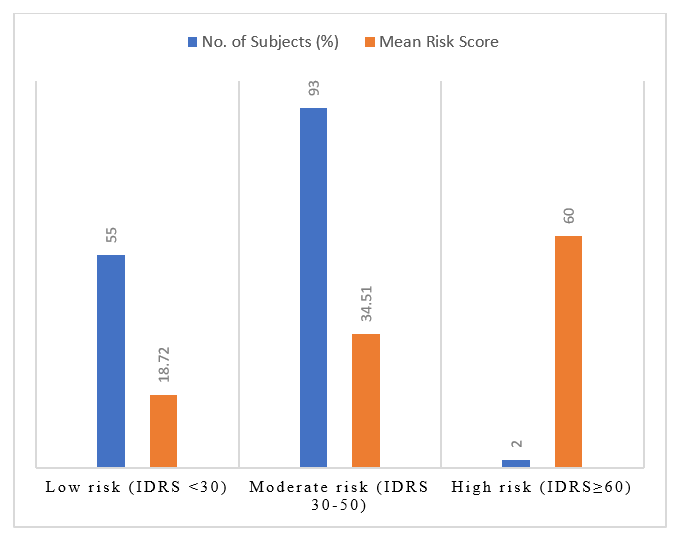
Diabetes mellitus is a major public health problem affecting all age groups with increasing trends seen in youth. IDRS can be used as a screening tool for assessing diabetes, metabolic syndrome and cardiovascular risk. A risk score of ≥ 30 is found to be optimally sensitive in identifying undiagnosed diabetes and detecting the risk of the same in earlier stages. In the present study 86 female and 64 male students participated and after administering IDRS, it was found that 1%, 62% and 37% subjects were found to be at high risk, moderate risk and low risk for developing T2DM with mean IDRS of 60, 34.51 & 18.72 respectively. Findings of this study were similar to the studies conducted by MM Singh et al[10], Gopalakrishnan et al.[11] and Bhatia et al.[14] The reports of present study showed positive family history of diabetes, decreased physical activity and increased abdominal circumference in 73 (48.7%), 21 (14%) and 32 (21.3%) respectively. The present study considered participants below 25 years of age, hence the effect of age on risk score was not observed. Nearly 50% (N= 73) of subjects had a positive family history of diabetes mellitus in either one or both the parents (either parent n=57, both parents n=16). The risk score was higher among the subjects with a family history of diabetes in one or both the parents and the difference was statistically significant (p value= 0.0001). These findings are in accordance with studies done by MM Singh et al. (41.5%), Gopalakrishnan et al. (46.6%) and Bhatia et al. (32%)[10, 11, 14]. Ajeet Singh Bhadoria et al.[15] studied validation of Indian Diabetic Risk score in diagnosing Type 2 Diabetes Mellitus against high fasting blood sugar levels among adult population of central India in 911 subjects indicated that IDRS has excellent predictive value for detecting undiagnosed diabetes in the community and IDRS is also a much stronger risk indicator than examining individual risk factors like age, family history, obesity, or physical activity. Anthropometric measurements such as WC, HC and BMI values were higher among subjects with moderate to high IDRS and was statistically significant for both WC (p=0.005) and HC (p=0.04). The present study reported statistically significant positive correlation of risk score with weight (p=0.01), BMI (p= 0.003), waist circumference (p=0.000) and hip circumference (p= 0.001) which signifies that these modifiable risk factors play an important role in identifying risk for diabetes and further for metabolic syndrome. Mohammad Mustufa Khan et al.[16] showed that 30.4% population were diabetic & 60.04% had central obesity and they concluded that IDRS is a valid and a cost-effective tool for screening and the study also reported, its combination with BMI value and HbA1c can be used for strict monitoring for diabetes and obesity to prevent complications in later life. Results of biochemical investigations such as total cholesterol, triglycerides, HDL, VLDL and LDL among participants with IDRS ≥ 30 was higher as compared to subjects with IDRS <30 but was not statistically significant. However, the association of metabolic syndrome components such as WC in males and triglycerides showed statistically significant association with moderate to high- risk groups. All these findings of the current study reveal that young adults having IDRS ≥30 with obesity and family history of diabetes may have increased risk for diabetes and metabolic syndrome and in turn cardiovascular risk.
Limitations: A cross-sectional nature of the study design doesn’t allow observations of time trend of diabetes risk. A single centred study with low sample size, hence the results cannot be generalized. As the study involved subjects below 25 years of age, the effect of age on diabetes risk could not be considered.
It is evident from the above results that large number (63%) of young medical students were in moderate to high-risk category for developing diabetes which warrants early detection and stringent and appropriate life style modifications among young adults. IDRS a cost-effective tool can be used among young adults for early detection of risk of diabetes, metabolic syndrome and cardiovascular disease.
The authors acknowledge the Indian Council of Medical Research (ICMR) for awarding the Short-Term Studentship (STS) to the first author. Authors would like to thank all the participants for their co-operation and Adichunchanagiri Institute of Medical Sciences, ACU for the infrastructural support.
1. The increasing burden of diabetes and variations among the states of India: the Global Burden of Disease Study 1990–2016. The Lancet Global Health. 2018; 6 (12). Available from: https://doi.org/10.1016/s2214-109x(18)30387-5
2. Temporal changes in prevalence of diabetes and impaired glucose tolerance associated with lifestyle transition occurring in the rural population in India. Diabetologia. 2004; 47 (5). Available from: https://doi.org/10.1007/s00125-004-1387-6
3. Kobberling J, Tillil H. Empirical risk figures for first-degree relatives of non-insulin-dependent diabetics. In: Kobberling J, editor. Genetics of Diabetes Mellitus. London: Academic; 1982; 201-209
4. Association of physical inactivity with components of metabolic syndrome and coronary artery disease—the Chennai Urban Population Study (CUPS no. 15). Diabetic Medicine. 2005; 22 (9). Available from: https://doi.org/10.1111/j.1464-5491.2005.01616.x
5. The Effects of Metformin on Body Mass Index and Glucose Tolerance in Obese Adolescents With Fasting Hyperinsulinemia and a Family History of Type 2 Diabetes. Pediatrics. 2001; 107 (4). Available from: https://doi.org/10.1542/peds.107.4.e55
6. A simplified Indian Diabetes Risk Score for screening for undiagnosed diabetes subjects. Journal of the Association of Physicians of India. 2005; 53 Available from: https://pubmed.ncbi.nlm.nih.gov/16334618/
7. A diabetes risk score helps identify metabolic syndrome and cardiovascular risk in Indians – the Chennai Urban Rural Epidemiology Study (CURES‐38). Diabetes, Obesity and Metabolism. 2007; 9 (3). Available from: https://doi.org/10.1111/j.1463-1326.2006.00612.x
8. Association of Indian Diabetes Risk Score with Arterial Stiffness in Asian Indian Nondiabetic Subjects: The Chennai Urban Rural Epidemiology Study (CURES-84). Journal of Diabetes Science and Technology. 2010; 4 (2). Available from: https://doi.org/10.1177/193229681000400214
9. Risk assessment of type-2 diabetes using the Indian diabetes risk score: a cross-sectional study on medical students from a tertiary care hospital. International Journal Of Community Medicine And Public Health. 2021; 8 (12). Available from: https://doi.org/10.18203/2394-6040.ijcmph20214607
10. Risk assessment of diabetes using the Indian diabetes risk score: A study on young medical students from Northern India. Indian Journal of Endocrinology and Metabolism. 2019; 23 (1). Available from: https://doi.org/10.4103/ijem.ijem_623_18
11. Assessing the risk of developing type 2 diabetes mellitus among medical students in Chennai using Indian diabetes risk score. International Journal Of Community Medicine And Public Health. 2017; 4 (7). Available from: https://doi.org/10.18203/2394-6040.ijcmph20172825
12. The Chennai Urban Rural Epidemiology Study (CURES) - Study Design and Methodology (Urban Component) (CURES - 1). Journal of the Association of Physicians of India. 2003; 51 Available from: https://pubmed.ncbi.nlm.nih.gov/14710970/
13. Executive Summary of The Third Report of The National Cholesterol Education Program (NCEP) Expert Panel on Detection, Evaluation, And Treatment of High Blood Cholesterol In Adults (Adult Treatment Panel III). JAMA: The Journal of the American Medical Association. 2001; 285 (19). Available from: https://doi.org/10.1001/jama.285.19.2486
14. Type 2 Diabetes Mellitus: Risk evaluation and Advice in undergraduate students in Mumbai. IJPSI. 2014; 3 (4). Available from: https://www.ijpsi.org/Papers/Vol3(4)/Version-2/G0342037040.pdf
15. Validation of Indian diabetic risk score in diagnosing type 2 diabetes mellitus against high fasting blood sugar levels among adult population of central India. Biomedical Journal. 2015; 38 (4). Available from: https://doi.org/10.4103/2319-4170.143508
16. Validity of Indian Diabetes Risk Score and its association with body mass index and glycosylated hemoglobin for screening of diabetes in and around areas of Lucknow. Journal of Family Medicine and Primary Care. 2017; 6 (2). Available from: https://doi.org/10.4103/2249-4863.220010
Subscribe now for latest articles and news.