Journal of Medical Sciences and Health
DOI: 10.46347/jmsh.v12.i3.26.8
Year: 2026, Volume: 12, Issue: 3, Pages: 268-273
Original Article
Viruksha A 1, Deepak Kumar Garg 2, Richa Singh 1, Veena Mathur 1, Deepika Meena 1, Kushank Sharma 1, Surendra Kumar Pingoliya 2
1Department of Anaesthesia, J.L.N. Medical College, Ajmer, Rajasthan, India.
2Department of Palliative Medicine, J.L.N. Medical College, Ajmer, Rajasthan, India.
Address for correspondence: Deepak Kumar Garg, Department of Palliative Medicine, J.L.N. Medical College, Ajmer, Rajasthan, India.
E-mail: [email protected]
Received Date:06 January 2026, Accepted Date:13 June 2026, Published Date:19 August 2026

Propofol is the most widely used intravenous anesthetic for anesthesia induction. However, discomfort during the intravenous administration of propofol remains a concern. Even with multimodal techniques, pain following a propofol injection is not completely removed. Colloids change the vascular endothelium, preventing certain molecules from activating on contact. Pre-administration of colloids may prevent propofol from activating the vascular endothelium, resulting in less discomfort during injection. To compare pre – administration of 0.9% Normal Saline and 6 % Hydroxyethyl Starch (HES) in decreasing pain on injection of propofol during intravenous induction of anaesthesia. The study population was randomly divided into two groups of 50 patients each, using a computer-generated database of random numbers. Prior to propofol induction, group H received 100 ml of 6% HES intravenously, and group C received 100 ml of 0.9% normal saline (NS) via IV. The severity of mild pain (34% in Group C vs 28% in Group H), moderate pain (34% in Group C vs 8% in Group H), and severe pain (12% in Group C vs 0% in Group H). Pain incidence was reduced in Group H (36%), compared to Group C, which was 80% during induction. Pain during the postoperative period was reported by 54% in Group C and 8% in Group H. PONV occurred in 16% of patients in group C and 24% in group H. Propofol injection pain was much lessened by pre-administration of 100 mL 6% HES, and there was less pain recall than with normal saline.
Propofol is the most commonly used intravenous anesthetic agent for inducing anesthesia, resulting in a smoother induction and faster recovery than alternative drugs such as thiopental[1]. Pain is an issue when propofol is delivered intravenously, however. After receiving an intravenous propofol infusion, 30 to 90 percent of patients report discomfort[2]. The phenol moiety of propofol causes pain because it irritates the skin and mucous membranes[3]. Other causes of pain include osmolality variations, pH, and the activation of pain mediators[4]. However, even with multi-modal approaches, discomfort following propofol injection is
not totally eliminated[5]. Propofol pain can be reduced or avoided by injecting it into a large vein, adjusting the rate of administration, or administering lidocaine intravenously with or without a tourniquet, ketamine, Pethidine, metoclopramide, or dexamethasone[6].
HES was developed based on its established effects on vascular permeability regulation, endothelial glycocalyx stability, and possible interaction with nociceptive pathways at the vascular endothelium[7]. The direct irritation of the venous endothelium and the stimulation of the kallikrein-kinin system, which results in the release of bradykinin and local vasodilatation, are thought to be the causes of propofol injection discomfort[8]. It has been demonstrated that colloid solutions like HES lessen endothelium disruption, which may possibly attenuate this cascade and lessen nociceptor stimulation[7]. Colloids are a safe option for intraoperative fluid therapy in anesthesia[9]. They are macromolecules with the ability to change endothelial cell junctions and vascular endothelial permeability, as well as prevent endothelial activation by a variety of chemicals[10]. Thus, pre-administration of colloids may
inhibit propofol contact activation, resulting in a reduction in discomfort during injection[11].
This study compared the effects of pre-administration of 0.9% normal saline and 6% hydroxyethyl starch on pain reduction after propofol infusion during intravenous anaesthesia induction.
Study Design:
A hospital-based, prospective, comparative, interven- tional investigation was undertaken in the anaesthesia inpatient department (IPD) of a tertiary care hospital.
Proposal Approval and ethical considerations
The study was started after receiving approval from the Institutional Research and Review Board and Ethics Committee (338/ Acad- III/MCA/2023) and the Clinical Trial Registry of India (CTRI number: CTRI/2024/01/061670). All patients who volunteered to participate in the trial provided written informed consent. Anonymity and confidentiality were maintained throughout the trial.
Study Participants:
Patients between the ages of 18 and 65 who belonged to ASA (American Society of Anaesthesiologists) Classes 1 and 2, weighed between 40 and 80 kg, and underwent elective surgery under general anesthesia were included in the study, which had a total sample size of Z = 100 (n = 50 in each group) based on a prior study at 95% confidence and 80% power and at alpha error 0.05. Patients who declined, age below 18 and above 65, ASA class 3 and 4, known hypersensitivity with propofol or HES, Patients having dyselectrolytemia, deranged renal and liver function test and any known systemic disease were excluded from the study. This is a double-blind trial, with the study medicines prepared by an independent anesthesiologist who was not involved in patient management or outcome evaluation and administered in identical syringes to maintain transparency.
Study Procedure and Outcome Measures:
The study population was randomly divided into two groups of 50 patients each, using a computer-generated database of random numbers. Prior to propofol induction, group H received 6% HES 100 ml intravenously, while group C received 0.9% normal saline (NS) 100 ml intravenously.
On the day before surgery, a pre-anaesthetic evaluation was performed, and patients provided written informed consent after the entire procedure was explained to them. Prior to surgery, patients were kept NPO overnight. Upon arrival in the operating room, a 16 or 18G cannula was placed, preferably into the forearm vein. Routine ASA monitoring, which includes pulse oximetry (SpO2), non-invasive blood pressure (NIBP), and an electrocardiogram (ECG), was implemented concurrently. The vital parameters were measured (heart rate, oxygen saturation, systolic, diastolic, and mean arterial pressure). No analgesic premedication was given to any patients. An anaesthesiologist not participating in the study prepared the study medicines, HES or NS, in two 50 mL syringes and gave them over to one of the study investigators, who administered them to the patient over a three to five-minute period. The injectant's arm was not tourniqueted. Patients were premedicated with an injection of glycopyrrolate 0.004 mg/kg i.v. once the 100 cc bolus had been completed. 100% O2 was used to preoxygenate for 3 minutes.
The investigator administered propofol 2.0 mg/kg iv to the patient until loss of verbal response, and tracheal intubation was conducted following injection of succinylcholine 2mg/kg iv with a cuffed sterile polyvinylchloride tracheal tube of adequate size. The tracheal tube cuff was inflated until no air leakage could be detected using a stethoscope at a peak airway pressure of 20 cm H2O. Tramadol 2mg/kg intravenously was administered. General anesthesia was maintained using oxygen (50%) in nitrous oxide (50%), injectable atracurium bromide (0.5mg/kg), and inhalational sevoflurane (MAC=1). Ondansetron 4mg injection was administered intravenously 30 minutes before the completion of the surgery.
After surgery, the oropharynx was gently suctioned and sevoflurane was switched off. The inspiratory oxygen concentration was increased to 100%. While waiting for spontaneous respiration to fully resume, the neuromuscular block was reversed with injections of neostigmine 0.5mg/kg iv and glycopyrrolate 0.008 mg/kg iv. Patients were extubated once they regained full consciousness and adequate muscle power. The heart rate, SpO2, blood pressure, and ECG were recorded at the two-minute, five-minute, ten-minute, and five-minute intervals during the surgery. Another investigator assessed pain during propofol injection using the McCormick and Hunter scale[12] every 5 to 10 seconds before the loss of verbal contact as follows: 0-no pain; 1-mild pain evident only on questioning after 10 seconds without any obvious discomfort; 2-moderate pain self-reported by patients within 10 seconds with some discomfort; and 3-severe pain accompanied by hand withdrawal, facial grimace/wincing, or howling/crying. Side effects such as postoperative nausea and vomiting were reported. All patients were asked to recollect if they had pain during the propofol injection in the recovery room, and the incidence of discomfort was classified as no recall or recall of pain present. Hemodynamic instability, allergic reactions, and clinical signs of renal, hepatic, or coagulation malfunction were all closely monitored in patients both during and after surgery.
Statistical Data Analysis:
Continuous data were expressed as mean ± SD, whereas categorical data were expressed as numbers or frequency (%). Statistical calculations were performed with SPSS software version 28.0. The data were compared using standard qualitative and quantitative procedures (e.g., paired and unpaired student t-tests, Chi-Square). The quantitative variables were examined using the unpaired student t test. Categorical variables were analyzed using the chi-square test. A p-value of <0.05 was judged statistically significant.
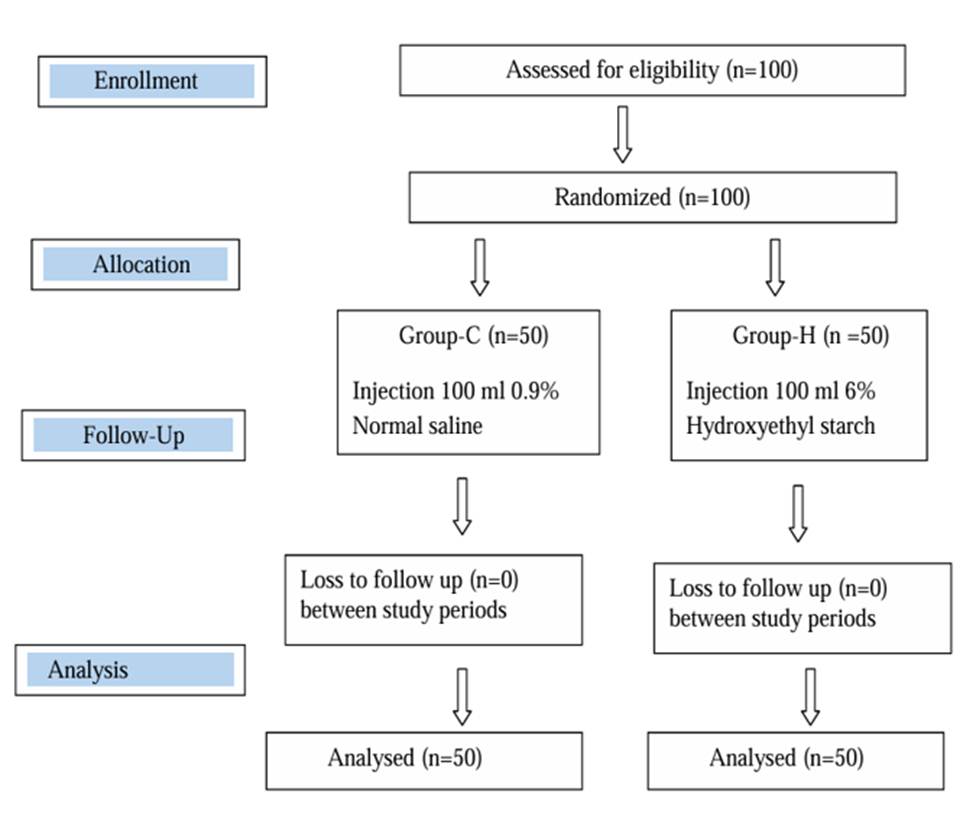
The study had a total of 100 patients. Groups H and C were not lost during the follow-up. Thus, data from 50 patients from each group were evaluated [Fig. 1].
Both Groups C and H were comparable in terms of demographic data (age, gender, weight) and the distribution of baseline vital indicators [Table. 1].
When the severity of pain during induction was compared between the two groups, group C patients experienced 20% no discomfort, 34% mild pain, 34% moderate pain, and 12% severe pain. In group H, 64% had no pain, 28% had mild pain, 8% had moderate pain, and no one had severe pain [Table. 2].
Pain was 80% present and 20% absent in Group C and 36% present and 64% absent in Group H. A statistically significant difference with p values (P=<0.0001) was found between the two groups, with Group H experiencing less discomfort (36%) during induction than Group C (80%) [Table. 3].
| Patient’s characteristics | Group – C (n=50) | Group – H (n=50) | P value |
|---|---|---|---|
| Age (years) (Mean ± SD) | 35.04± 10.77 | 33.32 ± 9.64 | 0.201(NS) |
| Gender (Female/Male) | 32/18 | 34/16 | 0.672(NS) |
| Weight (kg.) (Mean ± SD) | 48.33 ± 5.45 | 48.36 ± 6.74 | 0.490(NS) |
| Heart rate (bpm) (Mean ± SD) | 74.6 ± 5.43 | 73.6 ±3.08 | 0.130(NS) |
| SBP(mmHg (Mean ± SD) | 125 ± 4.96 | 124 ± 4.19 | 0.246(NS) |
| DBP (mmHg) (Mean ± SD) | 76.3 ± 4.01 | 77.7 ± 4.76 | 0.158(NS) |
| MAP (mmHg) (Mean ± SD) | 85.95 ± 7.90 | 96.70 ± 6.30 | 0.242(NS) |
| SpO2(%)(Mean ± SD) | 98.55 ± 0.85 | 98.6 ± 0.731 | 0.106(NS) |
|
Severity of Pain |
Group |
|||
|---|---|---|---|---|
|
Group C (n=50) |
Group H (n=50) |
|||
|
N |
% |
N |
% |
|
|
No |
10 |
20.0% |
32 |
64.0% |
|
Mild |
17 |
34.0% |
14 |
28.0% |
|
Moderate |
17 |
34.0% |
04 |
08.0% |
|
Severe |
06 |
12.0% |
00 |
0.0% |
|
Total |
50 |
100.0% |
50 |
100.0% |
|
P value |
0.00013(S) |
|||
|
Incidence of Pain |
Group C (n=50) |
Group H (n=50) |
||
|---|---|---|---|---|
|
N |
% |
N |
% |
|
|
No |
10 |
20.0% |
32 |
64.0% |
|
Yes |
40 |
80.0% |
18 |
36.0% |
|
Total |
50 |
100.0% |
50 |
100.0% |
|
P value |
0.0001(S) |
|||
Out of 50 patients, 54% of those in group C and only 8% of those in group H reported experiencing recalled pain throughout the postoperative phase, with a statistically significant difference (0.0001) [Table. 4].
|
Pain Recall |
Group |
|||
|---|---|---|---|---|
|
Group C (n=50) |
Group H (n=50) |
|||
|
N |
% |
N |
% |
|
|
No |
23 |
46.0% |
46 |
92.0% |
|
Yes |
27 |
54.0% |
04 |
8.0% |
|
Total |
50 |
100.0 |
50 |
100.0% |
|
P value |
0.00001(S) |
|||
Group C experienced 16% postoperative nausea and vomiting (PONV), while group H experienced 24%. There was no discernible difference in the incidence of PONV between the two groups (0.317) [Table. 5]. And no adverse renal or coagulation-related events were observed.
|
PONV |
Group |
|||
|---|---|---|---|---|
|
Group C (n=50) |
Group H (n=50) |
|||
|
N |
% |
N |
% |
|
|
No |
42 |
84.0% |
38 |
76.0% |
|
Yes |
08 |
16.0% |
12 |
24.0% |
|
Total |
50 |
100.0% |
50 |
100.0% |
|
P value |
0.317(NS) |
|||
Propofol is utilized for sedation outside of operating rooms due to its rapid onset, short duration, and ease of titration[13]. It operates on gamma aminobutyric acid receptors, modifies calcium entry via slow calcium ion channels, and directly inhibits the N-methyl-d-aspartate receptor[14]. Propofol infusion syndrome is an unusual yet significant adverse effect that can occur after using propofol[15]. Propofol injections can be painful for a variety of reasons, including medication properties such as emulsion composition, formulation pH, temperature, injection volume, and osmolarity[16]. The concentration of propofol in the aqueous phase, the speed of the IV carrier fluid, and the pace at which the medication is administered are all potential contributing variables to the detrimental effects of the drug injection approach[16].
A nonionic starch derivative called HES is utilized in resuscitation[17]. Its effectiveness as a volume expander has made it more well-liked in surgical and critical care settings for the treatment of hypovolemia[18]. They prevent endothelial activation brought on by certain chemicals and agents[19]. Therefore, it is suggested that pre-administration of starch can prevent propofol contact activation, which would lessen the discomfort associated with propofol injection[11]. Due to its appealing profile, propofol has been increasingly used in pediatric, cardiac, neuroanesthesia, daycare surgery, and intensive care unit sedation[20]. However, adverse symptoms like myoclonus, apnea, hypotension, and injection pain are also linked to it[3].
This study has important implications for therapeutic practice, particularly in lowering pain associated with propofol injections. Early researchers highlighted that, despite the drug's appealing features, the high incidence of pain during injection could limit its long-term usage[21]. The current study aimed to assess and compare the incidence of pain following propofol injection in patients receiving HES bolus versus Normal Saline. In our investigation, the distribution of baseline vital measures and demographic information (age, gender, and weight) were similar for both Group-C and Group-H.
In our study, the pain severity level was determined using the McCormick and Hunter score[12]. The pain severity levels in both groups were comparable. The pain intensity levels in Group C and Group H were compared, and it was discovered that mild pain (34% in Group-C vs 28% in Group-H), moderate pain (34% in Group-C vs 8% in Group-H), and severe pain (12% in Group-C vs 0% in Group-H). Thus, we found that the severity of pain during induction was lower in group H, with a statistically significant difference between the two groups (p = 0.00013). The proportion of patients feeling pain on propofol injection was observed to be much lower with the pre-administration of 6% HES than with the pre-administration of normal saline. A study by Sahoo TK et al.[22] examined the effectiveness of 2% lidocaine and 6% hydroxyethyl starch in lessening the pain associated with propofol injections. They discovered that administering 100 mL of 6% HES prior to propofol infusion can considerably lessen pain. When 6% HES was pre-administered instead of lidocaine, the percentage of patients who experienced pain during propofol injection was shown to be much lower.
Incidence of pain was lower in Group H was 36 % in comparison to Group C which was 80 % during induction. Both groups were comparable regarding incidence of pain with significant p values (P= <0.0001). Misra S et al.[11] observed that the overall incidence of pain was considerably lower in the HES group than in the NS group when comparing the pre-administration of 100 mL HES and 100 mL NS for the decrease of pain on propofol injection. This finding is consistent with the current study's findings. We discovered that administering a 100 ml bolus of HES or 0.9% NS over a period of three to five minutes in the veins of the hand or forearm, followed by induction with 1% propofol premixed with 2% lignocaine. They found that the NS group had a much greater overall incidence of discomfort than the HES group (53% vs. 28% with P = 0.004). A study by Varghese et al.[23] compared the effects of lidocaine and HES on the decrease of pain brought on by propofol injections. They discovered that using HES instead of lidocaine did not improve anything.
Additionally, we found in our study that Group C recalled pain at a rate of 54%, while Group H recalled pain at a rate of only 8%. As we have done in our study, no prior research has examined pain recall, which is crucial for patients' recovery following surgery. Twenty patients in all, with a maximum in Group H (24%) and a minimum in Group C (16%), had post-operative nausea and vomiting in our study. The findings were not statistically significant (p = 0.317). Ondansetron was administered intravenously to treat the vomiting, and no statistically significant difference was seen between the two groups. Wasinwong et al.[24] investigated whether 8 mg of ondansetron was superior to lidocaine or a placebo in reducing propofol injection-related pain.
We recognize that a number of proven and successful treatments, especially lidocaine with or without venous occlusion, are already advised to lessen the discomfort associated with propofol injections. Our study aimed to investigate a possible alternative strategy based on the endothelial-stabilizing capabilities of hydroxyethyl starch (HES), rather than to question or replace these conventional procedures.
Limitations:
This study had a small sample size and was conducted at a single location. Nevertheless, the authors were able to reduce pain even with this small sample size by pre-administering an arbitrary volume of 100 mL of HES, which needs to be standardized. We were unable to determine the patients' level of pain, and we did not use open-ended inquiries to evaluate their level of discomfort. Additionally, larger randomized controlled trials and multicenter research with a larger sample size are needed to confirm these intriguing findings.
Pre-administration of 100 mL 6% HES can greatly minimize pain after propofol injection. When HES was administered prior to normal saline, the percentage of patients who experienced discomfort during propofol injection was shown to be much lower. Therefore, it can be utilized as a pretreatment to improve patients' health with intraoperative stable hemodynamic parameters and a lower incidence of pain recall.
1. Propofol: a review of its pharmacodynamic and pharmacokinetic properties and use as an intravenous anaesthetic. Drugs. 1988; 35 (4). Available from: https://doi.org/10.2165/00003495-198835040-00002
2. Is propofol injection pain really important to patients?. BMC Anesthesiology. 2017; 17 (1). Available from: https://doi.org/10.1186/s12871-017-0321-7
3. Propofol: Therapeutic Indications and Side-Effects. Current Pharmaceutical Design. 2004; 10 (29). Available from: https://doi.org/10.2174/1381612043382846
4. Inflammatory mediators of pain. British Journal of Anaesthesia. 1995; 75 (2). Available from: https://doi.org/10.1093/bja/75.2.125
5. Khamzaevna SV. Efficiency estimation of multi-modal approach to anesthetic management of long-term, abdominal operative interventions. European science review. 2015(5-6):101-106.
6. Sameera R. Effectiveness of veno-occlusion with lignocaine for prevention of propofolinduced vascular pain at the Kenyatta National Hospital (Doctoral dissertation, University of Nairobi).
7. The Beneficial Effect of HES on Vascular Permeability and Its Relationship With Endothelial Glycocalyx and Intercellular Junction After Hemorrhagic Shock. Frontiers in Pharmacology. 2020; 11 Available from: https://doi.org/10.3389/fphar.2020.00597
8. A potential mechanism of propofol-induced pain on injection based on studies using nafamostat mesilate. British Journal of Anaesthesia. 1999; 83 (3). Available from: https://doi.org/10.1093/bja/83.3.397
9. Crystalloid versus Colloid for Intraoperative Goal-directed Fluid Therapy Using a Closed-loop System. Anesthesiology. 2018; 128 (1). Available from: https://doi.org/10.1097/aln.0000000000001936
10. Vascular Endothelial Cell Biology: An Update. International Journal of Molecular Sciences. 2019; 20 (18). Available from: https://doi.org/10.3390/ijms20184411
11. Effect of 6% hydroxyethyl starch pre-administration for reduction of pain on propofol injection: A placebo-controlled randomised study. Indian Journal of Anaesthesia. 2022; 66 (2). Available from: https://doi.org/10.4103/ija.ija_884_21
12. Quality of life in adult intradural primary spinal tumors: 36-Item Short Form Health Survey correlation with McCormick and Aminoff-Logue scales. Journal of Neurosurgery: Spine. 2013; 19 (6). Available from: https://doi.org/10.3171/2013.8.spine12706
13. Propofol: a review of its use in intensive care sedation of adults. CNS Drugs. 2003; 17 (4). Available from: https://doi.org/10.2165/00023210-200317040-00003
14. Propofol. Modern Anesthetics. 2008; Available from: https://doi.org/10.1007/978-3-540-74806-9_11
15. Propofol infusion syndrome: an overview of a perplexing disease. Drug Safety. 2008; 31 (4). Available from: https://doi.org/10.2165/00002018-200831040-00003
16. Propofol: Current Updates, Challenges, and Strategies for Improved Self-Nanoemulsifying Formulation. ACS Pharmacology & Translational Science. 2025; 8 (4). Available from: https://doi.org/10.1021/acsptsci.4c00745
17. A Systematic Review of Third-Generation Hydroxyethyl Starch (HES 130/0.4) in Resuscitation. Anesthesia & Analgesia. 2011; 112 (3). Available from: https://doi.org/10.1213/ane.0b013e31820ad607
18. Implementation of a whole of hospital sepsis clinical pathway in a cancer hospital: impact on sepsis management, outcomes and costs. BMJ Open Quality. 2018; 7 (3). Available from: https://doi.org/10.1136/bmjoq-2018-000355
19. Linking endothelial dysfunction with endothelial cell activation. Journal of Clinical Investigation. 2013; 123 (2). Available from: https://doi.org/10.1172/jci66843
20. Sedation in the Pediatric Intensive Care Unit: Current Practice in Europe. Mason’s Pediatric Sedation Outside of the Operating Room. 2025; Available from: https://doi.org/10.1007/978-3-031-68468-5_18
21. The abuse potential of propofol. Clinical Toxicology. 2010; 48 (3). Available from: https://doi.org/10.3109/15563651003757954
22. Efficacy of 6% Hydroxyethyl Starch and 2% Lidocaine in Reducing the Pain of Propofol Injection. Sultan Qaboos University Medical Journal. 2024; 24 (4). Available from: https://doi.org/10.18295/squmj.11.2024.071
23. To Compare the Effect of Reduction in Pain on Propofol Injection after Administration of 6% Hydroxyethyl Starch versus 2% Lidocaine. Annals of African Medicine. 2025; 24 (2). Available from: https://doi.org/10.4103/aam.aam_178_24
24. A comparison of ondansetron and lidocaine in reducing injection pain of propofol: a randomized controlled study. BMC Anesthesiology. 2022; 22 (1). Available from: https://doi.org/10.1186/s12871-022-01650-4
Subscribe now for latest articles and news.