Journal of Medical Sciences and Health
DOI: 10.46347/jmsh.v12.i3.25.364
Year: 2026, Volume: 12, Issue: 3, Pages: 280-286
Original Article
Kusuma 1, B Rajesh 2
1Professor and HOD, Department of Community Medicine, Shridevi Institute of Medical Sciences and Research Hospital, Tumkur, Karnataka, India.
2Professor & HOD, Department of Pharmacology, Shridevi Institute of Medical Sciences and Research Hospital, Tumkur, Karnataka, India.
Address for correspondence: Kusuma, Professor and HOD, Department of Community Medicine, Shridevi Institute of Medical Sciences and Research Hospital, Tumkur, Karnataka, India.
E-mail: [email protected]
Received Date:01 November 2025, Accepted Date:12 July 2026, Published Date:19 August 2026
Scientific research is an integral part of the medical education system. It builds students confidence in doing research work in future. However, there is lack of modules to incorporate research concept in the existing curriculum. Objectives are to determine knowledge and attitude regrading research among undergraduate medical students before and after intervention using case vignettes. Quasi experimental study design was used among participated 280 students. Case vignettes were used for intervention. Pre-tested, validated questionnaire was used for data collection. Correct answers given to application-based multiple-choice questions (MCQs) on knowledge was analysed and graded as poor; average and good. Attitude was analysed by using Likert scale- strongly disagree to strongly agree. Paired t test was used to compare pre-test and post test scores and P<0.05 was considered statistically significant. A statistically significant improvement in knowledge and attitude score was observed among study participants after intervention- interns (p 0.0001), phase III part I MBBS (p 0.029) in knowledge and attitude in interns (p 0.0030). Majority (>80%) of students across the phases agree that research enhances critical thinking and independent learning skills and should be part of the MBBS curriculum. However, lack of financial support, motivation, and time for research are the major barriers to conducting research. Case vignettes are useful to improve the immediate post-test score of knowledge in research. A smaller number of case vignettes and a smaller sample size are the limitations. Further studies are needed to develop and integrate research module in MBBS curriculum.
The medical education system is not complete without scientific research. Research is essential to achieving evidence-based clinical practice, which is a fundamental aspect of Indian Medical Graduate (IMG) education[1]. It is reinforced by the Guidelines for Medical Education Regulation (GMER)-2023 and 2024. However, the current curriculum for Competency Based Medical Education (CBME) does not include enough modules to include it.
Several studies have emphasized the significance of incorporating research into the curriculum for medical
undergraduates[2, 3]. However, integrating research-based competencies is challenging and necessitates significant planning, preparation and focus[4]. Medical students have few options for pursuing a career in research. Young, talented researchers can be students, and they opt to be supported and given prizes[5, 6].
Students can present their research projects during Continuing Medical Education (CME) and student conferences, which are organized especially for undergraduate medical students across India. This helps students feel more confident as young researchers and enhances the institution's reputation. It is becoming essential for students who want to pursue further education overseas to do minor research projects.
Vignettes are "short explanations of scenarios to which participants are asked to respond and share details about how they might manage things." Vignettes are frequently used to gauge knowledge and understanding of a particular diagnosis or clinical circumstance. Additionally, it assesses trainees' skill and proficiency in
carrying out the required tasks. One kind of qualitative research is the case vignette, in which study participants are presented with case scenarios and events and their views, opinions, beliefs, and attitudes are elicited[7].
After the National Medical Council (NMC) implemented CBME, there have been few studies conducted in India on undergraduate medical students' research knowledge and attitudes. However, research on education interventions to enhance students' research knowledge and attitudes is lacking.
Therefore, this study's goal is to enhance undergraduate medical students' research knowledge and attitude by using case vignettes as a teaching and learning tool.
Objectives:
To compare the scores obtained in application based multiple choice questions before and after an intervention for assessing knowledge in research among undergraduate medical students
To compare the questionnaire scores on attitude regarding research before and after an intervention using case vignettes
A quasi-experimental study was conducted in Shridevi Institute of Medical Sciences and Research Hospital, Tumkur among students of phase II, phase III part I MBBS and interns. CBME batch students from study population who were present at the time of intervention were included in the study. Students who were absent and not willing to participate were excluded. A total sample size of 280 (phase II-115, phase III part I MBBS -73 and interns-92) were selected using convenient sampling method.
Study tools:
An institutional Ethics Committee approval was taken prior to the study (Ref No.: SIMSRH/IEC/2024-25/316, Dated 25.05.2024). Pre-tested, validated questionnaire was used for data collection. The questionnaire and case vignettes were validated by experts. Case vignettes and item analysis in the questionnaire was done for clarity, appropriateness and relevance by experts in the medical education. Three questions sentence format were changed in knowledge-based questions and 2 items in attitude-based questionnaire were deleted as per experts’ opinion. A pilot test was conducted among twenty interns who were not part of the study to check for reliability of questionnaire. The data of pilot study was not included in the result analysis. The final questionnaire consisted of 10 questions on knowledge and 20 questions on attitude. The content item level validity index and reliability coefficient (Cronbach's alpha) of questionnaire was 0.9, and 0.88 respectively.
In a pre-scheduled session interaction was done among different phase students. The session was conducted for a period of two hours. A brief introduction about the study and its importance was given followed by a pre-test to the students who agreed to participate in the study. Four case vignettes were used during discussion. Students were asked to answer questions related to research in each case vignettes. During discussion of case vignettes various aspects of research - informed consent process and its importance, confidentiality, study design, plagiarism, literature tools, statistical software tools and protocol for scientific writing were covered to enhance students’ knowledge in research and improve their attitude regarding research. Post test was conducted at the end and comparison of pre and post test scores was done.
Knowledge was assessed by using an application based multiple choice questions. Each correct answer was allotted 10 marks and there were 10 questions; for 4 correct answers 40% score, 5 to 7 correct answers 50% to 70% score and 8 to 10 correct answers 80% to 100% score were allotted. Thus, knowledge score was categorised as poor (≤40% score); average (50% to 70% score) and good knowledge (80% to 100%). Attitude was analysed by using Likert scale- strongly disagree (1) to strongly agree (5). Mean and Standard deviation was calculated. Paired t test was used to compare pre-test and post test score; chi-square test for categorical variables. P<0.05 was considered statistically significant.
The study was conducted among 280 MBBS students including Phase II, Phase III part I and interns who agreed to participate in the study. Out of 155 phase II students, 35 students were absent at the time of intervention; five did not agree to participate; 115 students gave consent to participate. Out of 136 phase III part I students, 23 students were absent at the time of intervention; 40 did not agree to participate; 73 students gave consent to participate. Out of 101 interns, 92 gave informed consent to participate. Thus, from Phase II-115; Phase III part I- 73 and Interns-92 students’ knowledge and attitude regarding research was studied.
The knowledge score of pre-test and post-test was analysed. In pre-test, overall students (n=280) having poor knowledge was 26.78%(n=75), average knowledge in 51.07% (n=143) and good knowledge in 22.15% (n=62).
[Table. 1] shows the knowledge score of different phase students before intervention. An average score was high across the phases during pre- test. The difference observed between phases and level of knowledge was statistically significant.
|
Phase of MBBS |
Poor |
Average |
Good |
P value* |
|---|---|---|---|---|
|
Phase II (n=115) |
42 (37%) |
58 (50%) |
15 (13%) |
0 .000053 |
| Phase III part I (n=73) |
9 (12%) |
35 (48%) |
29 (40%) |
|
|
Interns (n=92) |
24 (26%) |
50 (54%) |
18 (20%) |
*P value is significant at <0.05 with chi-square value 24.89
[Table. 2] shows the knowledge score among different phases after intervention using case vignettes. Overall poor knowledge score was reduced to 18.21% (n=51), and good score was improved to 37.5% (n=105) among respondents. The difference observed between phases and level of knowledge was statistically significant.
|
Phase of MBBS |
Poor |
Average |
Good |
P value* |
|---|---|---|---|---|
|
Phase II (n=115) |
31(27%) |
68(59%) |
16(14%) |
< 0.00001. |
| Phase III part I (n=73) |
8(11%) |
23(32%) |
42(58%) |
|
|
Interns (n=92) |
12(13%) |
33(36%) |
47(51%) |
*P value is significant at <0.05 with chi-square value 47.57
[Fig. 1] and [Fig. 2] shows comparison of proportion of knowledge in pre and post-test in students of different phases.
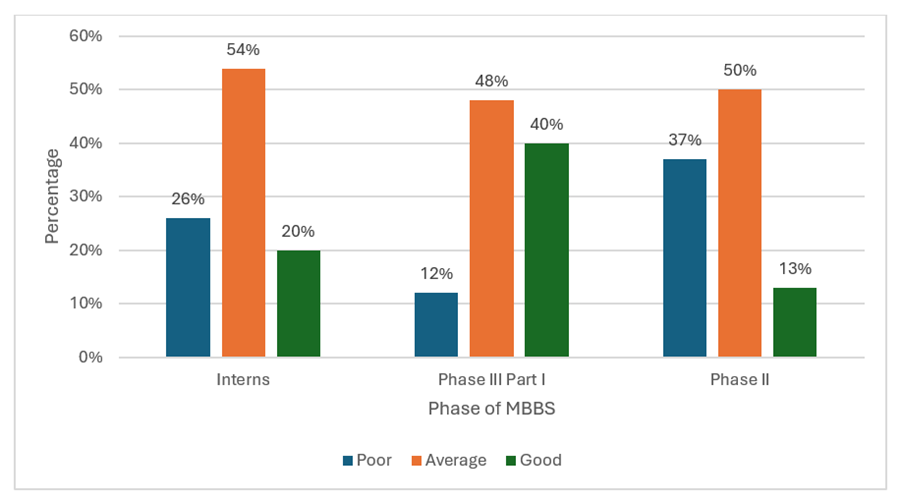
Bar diagram shows phase of MBBS horizontal axis and percentage of score in vertical axis. Phase III part I students have good score compared to interns and phase II students in pre-test.
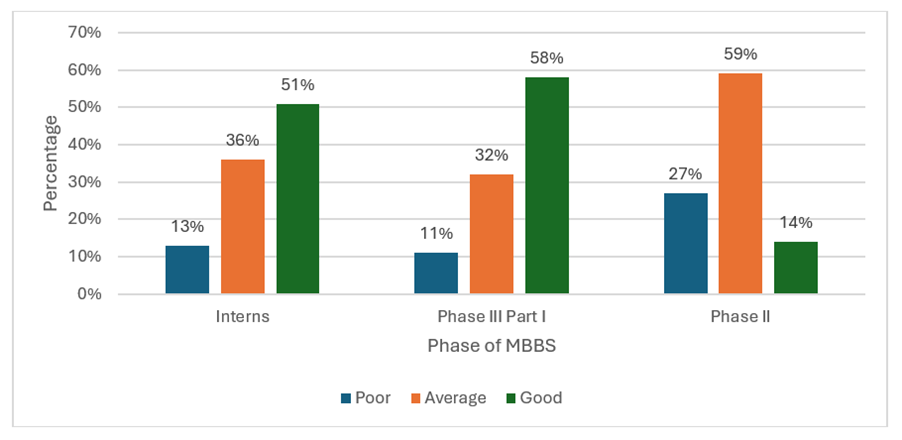
Bar diagram shows phase of MBBS horizontal axis and percentage of score in vertical axis. Interns’ good scores have increased to 51% and phase III part I to 58%. Students with poor scores have reduced across the phases in post-test. Phase II students average scores are increased in post test.
[Fig. 3] shows the barriers perceived by students for doing research. Overall, >80% students’ in all the phases agree that lack of formal syllabus on research in curriculum, and lack of time as major barriers for students’ research. Lack of funding support to do research was felt as barrier more by interns (80%) compared to their junior batch students- 67% in phase III part I and 52% in phase II MBBS students.
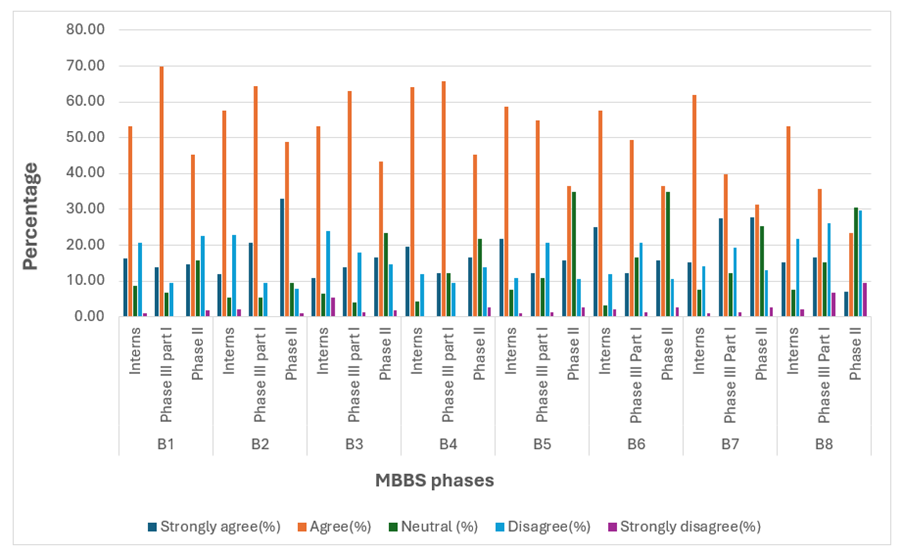
*B1=Lack of good mentoring on research by faculty; B2=Lack of syllabus on research methodology in MBBS curriculum; B3= Lack of self interest in doing research; B4=Lack of adequate motivation & support; B5=Lack of funding agency; B6= Lack of time to do research, because of heavy syllabus; B7=Lack of awareness on method of conducting research; B8=Lack of compulsion to conduct research projects in MBBS course.
Clustered bar diagram shows the students’ perception of barriers to research. Horizontal axis indicates different phase of MBBS and Likert’s scale of strongly agree, agree, neutral, disagree and strongly disagree. Vertical axis indicates the percentage of each scale response to barriers.
| Attitude | MBBS Phase | Strongly Agree (%) | Agree (%) | Neutral (%) | Disagree (%) | Strongly disagree (%) |
|---|---|---|---|---|---|---|
| Research promotes critical thinking |
Interns | 32% | 64% | 2% | 1% | 1% |
| Phase III part I | 31% | 62% | 7% | 0% | 0% | |
| Phase II | 25% | 53% | 17% | 3% | 1% | |
| Research to be part of MBBS curriculum |
Interns | 24% | 59% | 8% | 8% | 2% |
| Phase III part I | 18% | 62% | 11% | 8% | 1% | |
| Phase II | 39% | 50% | 11% | 0% | 0% | |
| Research promotes independent learning ability |
Interns | 25% | 64% | 5% | 4% | 1% |
| Phase III part I | 23% | 67% | 5% | 4% | 0% | |
| Phase II | 28% | 62% | 10% | 0% | 0% | |
| Rewards & encouragement is essential for students’ research |
Interns | 37 | 55% | 4% | 2% | 1% |
| Phase III part I | 38% | 53% | 5% | 3% | 0% | |
| Phase II | 39% | 54% | 5% | 2% | 0% | |
| Conducting research at UG level boosts confidence during PG |
Interns | 26% | 62% | 3% | 8% | 1% |
| Phase III part I | 25% | 63% | 8% | 4% | 0% | |
| Phase II | 36% | 51% | 10% | 3% | 0% | |
| Research will not lead to better clinical practice in future. |
Interns | 5% | 27% | 4% | 47% | 16% |
| Phase III part I | 0% | 18% | 5% | 59% | 18% | |
| Phase II | 1% | 8% | 15% | 53% | 23% | |
| Research should be done only by experts and not by UG students |
Interns | 9% | 37% | 5% | 37% | 12% |
| Phase III part I | 4% | 16% | 11% | 55% | 14% | |
| Phase II | 3% | 6% | 16% | 57% | 18% | |
| I am not interested to attend research methodology workshops |
Interns | 8% | 34% | 5% | 43% | 10% |
| Phase III part I | 4% | 25% | 16% | 48% | 7% | |
| Phase II | 1% | 8% | 33% | 43% | 16% | |
| I would like to present my research work at a conference and/or publish in a journal |
Interns | 13% | 59% | 9% | 17% | 2% |
| Phase III part I | 12% | 48% | 16% | 23% | 0% | |
| Phase II | 21% | 37% | 37% | 4% | 0% | |
| I am not interested to become part of research project undertaken by faculty |
Interns | 10% | 32% | 9% | 41% | 9% |
| Phase III part I | 5% | 30% | 19% | 36% | 10% | |
| Phase II | 3% | 8% | 28% | 46% | 15% | |
| I am interested in doing research projects during MBBS course |
Interns | 17% | 52% | 7% | 22% | 2% |
| Phase III part I | 12% | 45% | 21% | 21% | 1% | |
| Phase II | 23% | 34% | 37% | 3% | 3% | |
| I am interested in doing research, myself rather than in a team |
Interns | 10% | 41% | 10% | 36% | 3% |
| Phase III part I | 4% | 25% | 15% | 52% | 4% | |
| Phase II | 6% | 20% | 37% | 31% | 6% |
| Variable |
Interns (n=92) |
Phase III Part I (n=73) |
Phase II (n=115) |
|||||||||
|---|---|---|---|---|---|---|---|---|---|---|---|---|
| Pretest mean & SD | Post test mean & SD | 95% CI | p value (<0.05) | Pretest mean & SD | Post test mean & SD | 95% CI | p value (<0.05) | Pretest mean & SD | Post test mean & SD | 95% CI | p value (<0.05) | |
| Knowledge | 5.92 & ±2.11 | 7.25 & ±2.29 | 0.69 to 1.97 | 0.0001* |
6.75 & ±1.79 |
7.32 & ±2.09 |
0.06 to 1.06 | 0.029* |
5.3 & ±1.79 |
5.35 & ±1.7 |
-0.40 to 0.51 |
0.82 |
| Attitude |
40.43 & ± 4.04 |
42.28 & ±5.08 |
0.64 to 3.05 | 0.0030* | 40.36 & ±2.45 | 40.48 & ±3.24 | -0.64 to 0.88 | 0.748 | 40.38 & ±3.05 |
40.34 & ± 3.27 |
-0.86 to 0.78 |
0.91 |
| Barriers |
28.53 & ±4.71 |
29.63 & ± 4.92 |
-0.11 to 2.31 | 0.074 | 29.55 & ±3.44 |
29.42 & ± 4.57 |
-1.12 to 0.87 | 0.801 | 27.93 & ±6.06 |
27.46 & ±5.14
|
-0.96 to 1.91 |
0.514 |
*P value <0.05 is statistically significant
Attitude of students towards research was analyzed. [Table. 3] shows the attitude of MBBS students on research. Students had positive attitude across the phases prior to and after intervention. After intervention, more than 80% of students felt that research promotes critical thinking, independent learning ability and doing research projects should be part of MBBS curriculum. It was observed that interns had more positive attitude for research followed by phase III and phase II students respectively. Phase II students chose to be more neutral in their assertion of attitude compared to other phases students. However, their interest in conducting research work in MBBS and present in conferences or doing publication in journals is high compared to other phases. Students were interested in being part of research team rather than doing individually and were interested to present in the conference with good mentoring by faculties.
[Table. 4] shows the effect of education intervention on knowledge, attitude and barriers for research by comparison of pre and post-test scores. The difference observed in knowledge and attitude of interns and knowledge of phase III part I students after intervention was statistically significant. Even though there was improvement in mean score in perception on barriers to conduct research across phases after intervention, no statistically significant difference was found.
In our study, good knowledge score (80% to 100%) was observed in 22.15% of total responses and after intervention the number of students scoring was raised to 37.5% which implies that the case vignettes are useful as teaching learning method. Our study result is much lower than Pallamparthy S et al.[8], report (70%) but
much higher than Rajan B et al.[9], (4.6%). In our study 51.07% had average knowledge score higher than the study report of Chellaiyan VG et al., (36.9% adequate knowledge)[1]. Even though other studies don’t show any education intervention, the study helps to know the baseline knowledge among undergraduate students.
In our study as the phase of students increases, knowledge also had shown to be better. Studies had shown knowledge score of undergraduate medical students ranged from 69% to 81.7%. Sample size, methodological variations and sampling methods could be the causes for disparity in knowledge scores[8,10.11].
In our study, students in internship showed a statistically significant improvement in knowledge and attitude regarding research compared to their junior batch students. According to a study done in Jordan by Abusamak M et al., the knowledge score rose with each additional year of education[12]. Similar findings were made by Khan et al., who noted that as each successive academic year came to an end, knowledge about research gradually increased[13].
In our study we found that >80% undergraduate students had strong positive attitude towards research. Students strongly believe that research fosters critical thinking skills and the capacity for autonomous learning. Our study's findings are comparable to those of Rajan B et al[9].
In our study, >90% of students perceive that research should be included as part of MBBS curriculum and >50% had positive attitude for training in research methodology. Similar type of outcome was noted in the research findings of Pallamparthy S et al[8]. According to a study by Patil AB et al., since students have a good attitude and are interested in attending training workshops on research methodology, they might benefit from research methodology training workshops being more integrated into the MBBS curriculum[14]. In a study conducted by Alghamdi KM et al., 67.4% students positively stated that policy to be drawn to do research mandatorily by medical students[15].
Our study revealed that lack of time, motivation and guidance as major barrier for students’ research. Lack of funding support to do research was felt as a barrier more by interns compared to their junior batch students. Regarding the necessity of incentives and support as a crucial component of students' research, phase II students disagree more than interns and phase III part I students. Nonetheless, they wish to be more neutral when it comes to undergraduate research, which aids in postgraduate studies. Similar type of observations was made in studies conducted by Vairamani CR et al., in Manipur, northeastern India, among postgraduate students and interns. The main obstacles found in their study were a lack of training (87%), funding (76%), motivation (67%), and a mentorship program (66%)[16]. Study by Abusamak M et al. from Jordan also contained similar report[12]. Mosa AA et al., study conducted in Iraq discovered that the two main obstacles preventing students from actively participating in research are a lack of time (60%) and inadequate skills (52%)[17]. In a study conducted by Rajan B et al., in Kerala in medical students of different phases discovered that lack of time was a major obstacle for 80.5% of them due to educational tasks, and that 78.5% were unfamiliar with research techniques and statistical analysis. According to 58.1% of participants, lack of guidance constituted a hindrance, while 53.8% participants reported lacking funding and 39.9% of them had lack of interest in the research[9].
In our study, training was conducted using case vignettes as teaching method. The study shows that after training students’ knowledge and attitude towards research had shown improvement. In Iran, an RRE program identifies students who were interested in conducting research and divides them into groups according to their areas of interest. These students were trained by planning a workshop on research methods with faculty members who were subject experts. It was found that RRE program was successful in producing the intended outcomes[18].
Systematically conducted scientific research not only enables the confirmation of theories and hypotheses they also play a significant role in development of health care guidelines[19]. Early exposure and involvement of medical students in research in the initial years of their medical training might help them become better doctors and may assist residents in taking better career-related decisions[20-23].
Case vignettes are useful tools to improve the immediate post-test score of knowledge in research. Majority of students concur that research improves critical thinking and independent learning abilities and ought to be included in the MBBS curriculum, despite the fact that there is no statistically significant difference between the attitude scores before and after the intervention. However, the main obstacles to conduct research are lack of funding, enthusiasm, and time. The study is limited by being a single centre study, a lower sample size and fewer case vignettes. The study excluded students in Phase I and Phase III, part 2 of MBBS. Further studies are needed to explore the utility of case vignettes in enhancing knowledge and attitude towards research to create modules that can be incorporated into the MBBS curriculum.
Acknowledgment: We acknowledge Dr. Nachiket Shankar and Dr. Soumya Umesh, St. John’s Medical college for mentoring in successfully completion of this ACME project. We acknowledge students who enthusia- stically participated and shown interest in acquiring skills.
Funding support: Nil.
Conflict of interest: Nil.
Presentation at a meeting: ACME (Advanced Course Medical Education) workshop. Organisation: St. John’s medical college, NMC nodal centre. Place: Bangalore. Date: 24/8/24.
1. Medical research: Perception and barriers to its practice among medical school students of Chennai. Journal of Education and Health Promotion. 2019; 8 (1). Available from: https://doi.org/10.4103/jehp.jehp_464_18
2. The Role and Scope of Research in Undergraduate Medical Curriculum. Journal Of Clinical And Diagnostic Research. 2018; 12 (10). Available from: https://doi.org/10.7860/jcdr/2018/36808.12135
3. Saudi Meds: A competence specification for Saudi medical graduates. Medical Teacher. 2011; 33 (7). Available from: https://doi.org/10.3109/0142159x.2011.578180
4. Faculty perspective on competency-based research education: A multi-centre study from Saudi Arabia. Journal of Health Specialties. 2017; 5 (3). Available from: https://doi.org/10.4103/jhs.jhs_145_16
5. Fostering research skills in undergraduate medical students through Mentored Student Projects: Example from an Indian medical school. Kathmandu University Medical Journal. 2012; 8 (3). Available from: https://doi.org/10.3126/kumj.v8i3.6215
6. Awareness about medical research among resident doctors in a tertiary care hospital: A cross-sectional survey. Perspectives in Clinical Research. 2012; 3 (2). Available from: https://doi.org/10.4103/2229-3485.96446
7. Development of Case Vignette Tool on ECG and its Interpretation (CVECGI). International Journal of Innovative Science and Research Technology. 2021; 6 (5). Available from: https://www.ijisrt.com/assets/upload/files/IJISRT21MAY546.pdf
8. Knowledge, attitude, practice, and barriers toward research among medical students: A cross-sectional questionnaire-based survey. Perspectives in Clinical Research. 2019; 10 (2). Available from: https://doi.org/10.4103/picr.picr_1_18
9. Knowledge, attitude, practices, and perceived barriers towards research among undergraduate medical students in a teaching hospital: A cross-sectional study. Journal of Medical and Scientific Research. 2025; 13 (1). Available from: https://doi.org/10.17727/jmsr.2024/13-13
10. Knowledge, attitude, practice and barriers for research amongst medical students of GMC, Nagpur. Journal of Research in Medical and Dental Science. 2021; 9 Available from: https://www.jrmds.in/articles/knowledge-attitude-practice-and-barriers-for-research-amongst-medical-students-of-gmc-nagpur-70252.html
11. Are Medical Students Inclined to do Research?”. Journal of Clinical and Diagnostic Research. 2013; 7 Available from: https://doi.org/10.7860/jcdr/2013/6698.3786
12. Knowledge, attitudes, practices and barriers of medical research among undergraduate medical students in Jordan: a cross-sectional survey. BMC Medical Education. 2024; 24 (1). Available from: https://doi.org/10.1186/s12909-023-05002-9
13. Knowledge and attitudes about health research amongst a group of Pakistani medical students. BMC Medical Education. 2006; 6 (1). Available from: https://doi.org/10.1186/1472-6920-6-54
14. Attitude of undergraduate medical students towards medical research: A cross-sectional study. The National Medical Journal of India. 2025; 38 (3). Available from: https://doi.org/10.25259/nmji_987_2021
15. Perceptions, attitudes and practices toward research among senior medical students. Saudi Pharmaceutical Journal. 2014; 22 (2). Available from: https://doi.org/10.1016/j.jsps.2013.02.006
16. Knowledge, attitude and perceived barriers towards conducting research among students in a medical college, India. International Journal Of Community Medicine And Public Health. 2018; 5 (2). Available from: https://doi.org/10.18203/2394-6040.ijcmph20180273
17. Medical Students’ Knowledge, Attitude, Practice, and Perceived Barriers Towards Medical Research: A Cross-Sectional Study. Galician Medical Journal. 2023; 31 (1). Available from: https://doi.org/10.21802/e-gmj2023-a09
18. Rapid research education for medical science students. The Lancet. 2013; 381 (9873). Available from: https://doi.org/10.1016/s0140-6736(13)60800-4
19. Knowledge, attitudes, practices and perceived barriers towards research in undergraduate medical students of six Arab countries. BMC Medical Education. 2022; 22 (1). Available from: https://doi.org/10.1186/s12909-022-03121-3
20. Knowledge, attitudes, and barriers toward research: The perspectives of undergraduate medical and dental students. Journal of Education and Health Promotion. 2018; 7 (1). Available from: https://doi.org/10.4103/jehp.jehp_61_17
21. Why Medical Students Are Crucial to the Future of Research in South Asia. PLoS Medicine. 2005; 2 (11). Available from: https://doi.org/10.1371/journal.pmed.0020322
22. Are medical students interested in research? – students’ attitudes towards research. Annals of Medicine. 2022; 54 (1). Available from: https://doi.org/10.1080/07853890.2022.2076900
23. Contemporary global perspectives of medical students on research during undergraduate medical education: a systematic literature review. Medical Education Online. 2018; 23 (1). Available from: https://doi.org/10.1080/10872981.2018.1537430
Subscribe now for latest articles and news.